
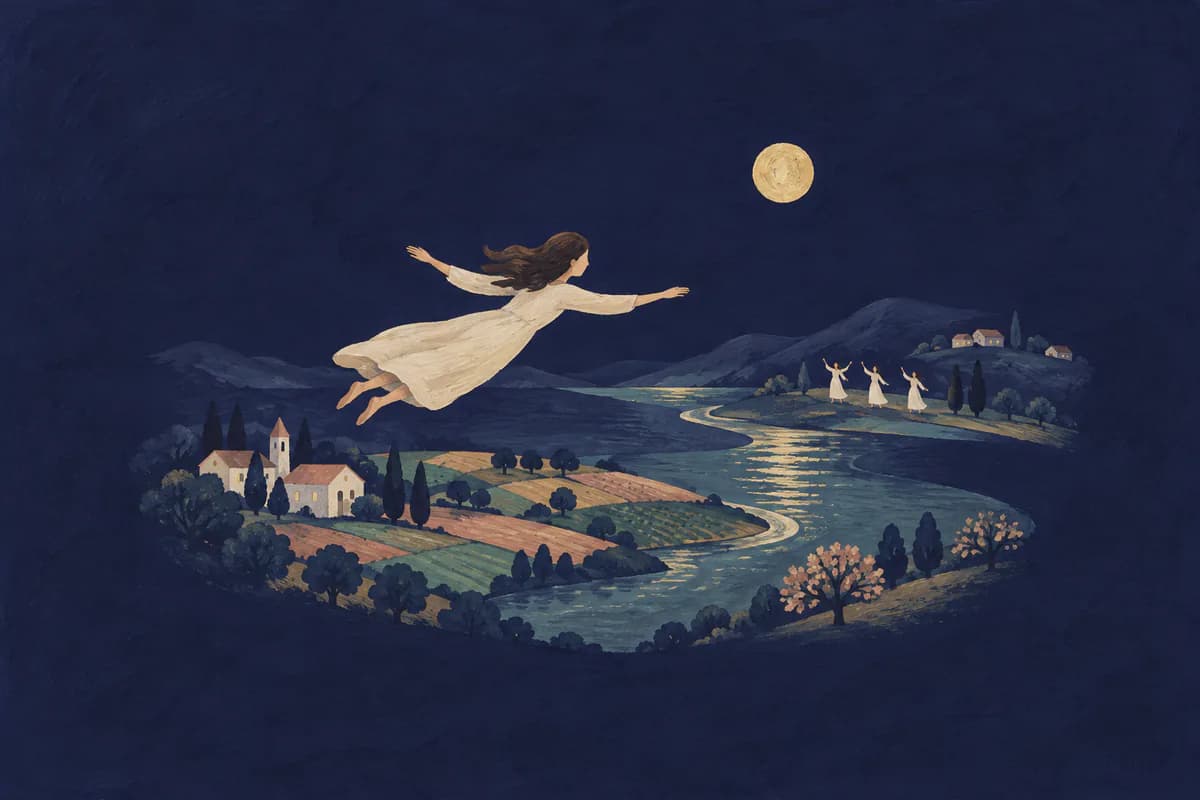
Harriet Tubman1840s, before and during her escape; published 1869
Harriet Tubman's dreams of flying to freedom
Before she escaped slavery, Tubman dreamed of flying over fields and rivers to a line she could not cross, until women in white reached out and pulled her over.
DraftAn editor has not reviewed this page yet.
The dream
Retold in our own words from the sources below, not quoted.
Harriet Tubman told her biographer that before her escape she dreamed again and again of a line, with green fields and flowers on the other side and women dressed in white stretching out their arms to her. In the early dreams she always fell before she could reach them.
In another dream, told to a Boston newspaper, she flew over fields, towns, rivers and mountains, looking down on them like a bird, until she came to a great fence or river that she had no strength to cross. Then the women in white put out their arms and pulled her across. She said that when she did escape, she recognised places from these dreams, and some of the people who helped her.
- Bradford 1869
Where the story comes from
Tubman escaped from slavery in Maryland in 1849 and returned many times to lead others north. As a teenager she had been struck on the head with a heavy weight, and for the rest of her life she had sudden spells of deep sleep and vivid dreams and visions, which she understood as messages from God.
Our main source is Sarah Bradford's Scenes in the Life of Harriet Tubman (1869), written from Tubman's own telling to raise money for her. Bradford rendered her speech in dialect and sometimes in her own words, so we paraphrase.
How it has been read
History
For Tubman, dreams and visions were part of her faith and of how she made life-and-death decisions on the road. The historian Kate Clifford Larson connects the spells and visions to her head injury, while stressing that Tubman's own religious understanding of them shaped everything she did.
- Larson 2004
Research
Flying dreams are among the most commonly reported typical dreams, and dreams about a barrier you cannot cross are familiar to many people living under constraint. Hers read almost as a map of her waking situation: freedom visible, the border deadly, and help coming from others.
- Nielsen et al. 2003
- Domhoff 2003
Questions for your own dreams
- When you fly in dreams, where are you trying to get to?
- Is there a line in your life that you can see across but not yet cross?
- Who are the people who might pull you over it?
Symbols in this dream
Had a dream that stayed with you?
Tell us your dreamSources
Every reading on this page comes from these works. Page references have not all been checked yet; those still waiting are marked.
Sarah H. Bradford (1869). Scenes in the Life of Harriet Tubman. Auburn, NY: W. J. Moses.
public domain
- Cited at: pp. 15-16 and 79-80 (reference not yet checked)
Kate Clifford Larson (2004). Bound for the Promised Land: Harriet Tubman, Portrait of an American Hero. New York: Ballantine Books.
cited, not reproduced
- Cited at: chapter on her injury and faith (reference not yet checked)
Tore A. Nielsen, Antonio L. Zadra, Valérie Simard, Sébastien Saucier, Philippe Stenstrom, Carlyle Smith, Don Kuiken (2003). The typical dreams of Canadian university students. Dreaming 13(4): 211-235.
cited, not reproduced
- Cited at: typical dream themes, including flying (reference not yet checked)
Survey of how many people report having had common dream themes (being chased, falling, teeth, flying, exams, nakedness and others) at least once.
G. William Domhoff (2003). The Scientific Study of Dreams: Neural Networks, Cognitive Development, and Content Analysis. Washington, DC: American Psychological Association.
cited, not reproduced
- Cited at: continuity hypothesis (reference not yet checked)