
Carl Gustav Jung1909, on the voyage to America with Freud
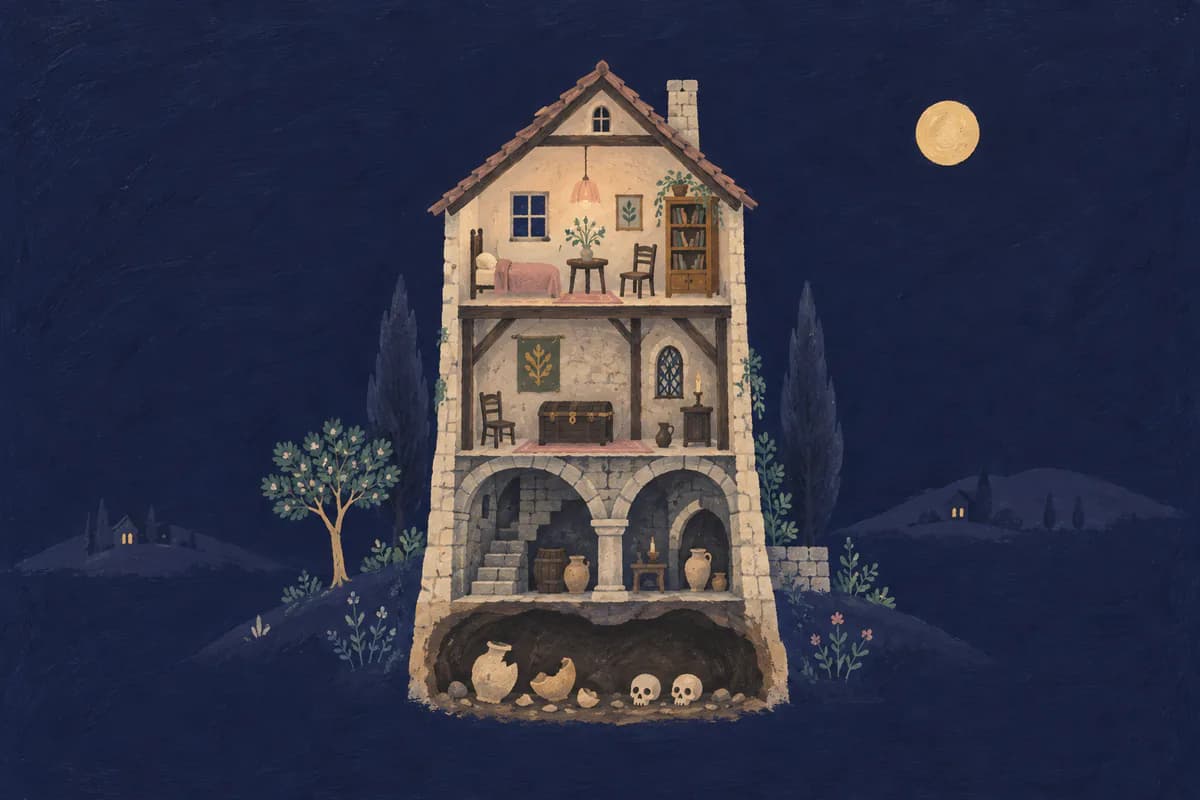
Jung's dream of the house with many floors
Travelling with Freud, Jung dreamed of going down through a house into older and older layers. He later said it was where his idea of the collective unconscious began.
DraftAn editor has not reviewed this page yet.
The dream
Retold in our own words from the sources below, not quoted.
Jung dreamed he was on the upper floor of a house he knew was his own, furnished in an old but pleasant style. Going downstairs he found the ground floor older still, medieval in feel. Beneath it a stone stairway led to a vaulted cellar that looked Roman.
In the cellar floor he found a stone slab with a ring. Lifting it, he went down narrow steps into a low cave full of dust, scattered bones and broken pottery, where he found two human skulls, very old and half crumbled. Then he woke.
- Jung 1963
Where the story comes from
Jung and Freud travelled together to Clark University in Massachusetts in 1909, analysing each other's dreams on the way. Jung described this dream and the conversation about it in Memories, Dreams, Reflections, published after his death in 1961 and compiled with Aniela Jaffé.
By Jung's account Freud focused on the two skulls and pressed him to say whose death he might be wishing for. Jung, who disagreed, gave him an answer he did not believe: his wife and his sister-in-law. The episode is often told as an early sign of the break between the two men in 1913.
How it has been read
Psychoanalysis
Jung read the house as an image of the psyche: the lived-in upper floor as consciousness, and each lower level as an older layer of the mind, down to a primitive layer shared by all people. He later called that layer the collective unconscious.
- Jung 1963
History
Memories, Dreams, Reflections was written late in Jung's life and shaped by an editor, and it presents his past in the light of theories he developed afterwards. It is the only source for the dream, so it tells us how Jung wanted it understood as much as what he saw in 1909.
- Jung 1963
Questions for your own dreams
- If your mind were a house, which room would you rather not go down to?
- Have you ever found a hidden room or floor in a dream?
- Who in your life do you tell your dreams to, and do they read them your way?
Symbols in this dream
Had a dream that stayed with you?
Tell us your dreamSources
Every reading on this page comes from these works. Page references have not all been checked yet; those still waiting are marked.
C. G. Jung (1963). Memories, Dreams, Reflections, translated by Richard and Clara Winston. New York: Pantheon.
first published 1962 (German)
cited, not reproduced
- Cited at: chapter "Sigmund Freud" (reference not yet checked)
- Cited at: introduction by Aniela Jaffé (reference not yet checked)
Recorded and edited by Aniela Jaffé; not an autobiography written by Jung alone.