
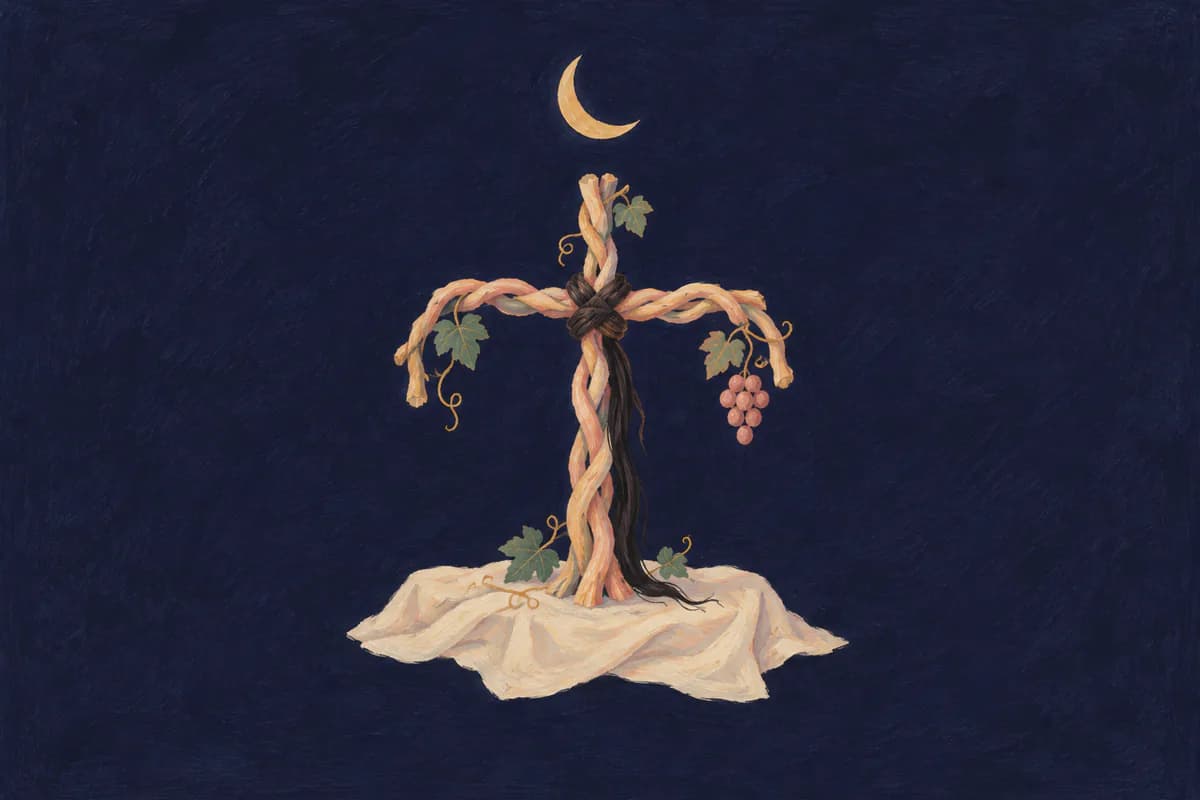
Saint Nino, Enlightener of GeorgiaEarly 4th century CE (tradition)
Saint Nino and the cross of vines
Georgia's best-loved sacred story begins with a dream: the Virgin Mary gives a young woman a cross made of grapevine and sends her to Kartli.
Esta página aún no está disponible en el idioma que elegiste (Español), así que estás viendo la versión en inglés.
BorradorEsta página aún no ha sido revisada por un editor.
El sueño
Narrado con nuestras propias palabras a partir de las fuentes indicadas abajo, sin citas textuales.
In the Georgian Life of Saint Nino, the young Nino longs to go to Kartli, in what is now Georgia, where tradition held that the robe of Christ had been taken. While she prays about it, the Virgin Mary appears to her in a dream and tells her to go and preach there, promising to protect her.
The Virgin gives her a cross made of grapevine branches as a shield. When Nino wakes, she is holding the cross in her hands. She binds it with strands of her own hair and sets out.
- Life of St. Nino 1900
De dónde viene la historia
Nino is honoured as the woman who brought Christianity to Kartli in the fourth century, and the grapevine cross, with its drooping arms, became a national symbol of Georgia. A cross associated with her is kept at Sioni Cathedral in Tbilisi.
The earliest account of a captive woman converting the Iberian royal family, by the Latin historian Rufinus around 402 CE, does not mention the dream or the cross. Those details come from the later Georgian lives of Nino, which exist in several medieval versions that differ from one another.
Cómo se ha interpretado
Historia
Rufinus heard his version from a Georgian prince in Palestine, only a few generations after the events. The Georgian Life, in the form translated by Marjory and Oliver Wardrop in 1900, is a much later and richer hagiography. The dream is part of how Georgians came to tell their own conversion, not an independent record.
- Rufinus 1997
- Life of St. Nino 1900
Escrituras
A dream in which a holy figure gives a sign and a mission belongs to a long Christian pattern, from Joseph in Matthew's gospel to the saints' lives. Waking with the gift still in her hands marks this one as more than a dream in the telling: the object proves the vision.
- Life of St. Nino 1900
Preguntas para tus propios sueños
- Has a dream ever felt like permission to do something you already longed for?
- What object would you want to wake up holding after a dream?
- Where in your life do you feel called, and what makes you hesitate?
Símbolos de este sueño
¿Has tenido un sueño que no has podido olvidar?
Contar mi sueñoFuentes
Todas las interpretaciones de esta página se basan en estas obras. Aún no se han comprobado todas las referencias a páginas; las pendientes están marcadas.
Anonymous (Georgian hagiography) (1900). Life of St. Nino, in Studia Biblica et Ecclesiastica, vol. V, part I, traducción de Marjory Wardrop and J. O. Wardrop. Oxford: Clarendon Press.
dominio público
- Ubicación de la cita: Life of St. Nino (referencia aún sin comprobar)
English translation of the Georgian Life of Nino; the Georgian texts are medieval.
Rufinus of Aquileia (1997). The Church History of Rufinus of Aquileia, Books 10 and 11, traducción de Philip R. Amidon. New York and Oxford: Oxford University Press.
primera publicación: c. 402 CE
citado, no reproducido
- Ubicación de la cita: Book 10, ch. 11 (referencia aún sin comprobar)