
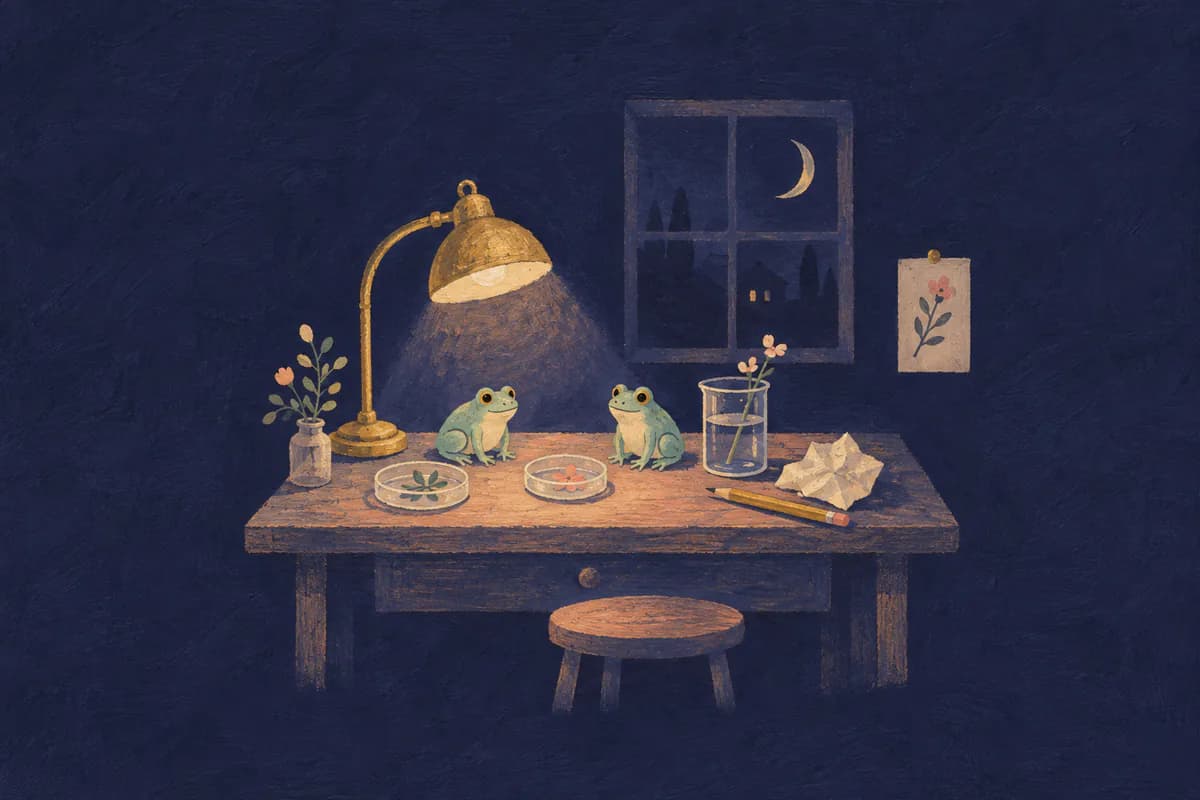
Otto LoewiEaster weekend, 1921
Otto Loewi's Nobel Prize dream
A pharmacologist dreamed an experiment, lost it, dreamed it again the next night and went straight to his lab. It proved that nerves speak in chemicals.
Esta página ainda não está disponível no idioma Português (Brasil), por isso você está lendo a versão em inglês.
RascunhoEsta página ainda não foi revisada por um editor.
O sonho
Recontado com nossas próprias palavras a partir das fontes abaixo, sem citação literal.
Otto Loewi wrote that on the night before Easter Sunday 1921 he woke, turned on the light and scribbled a few notes on a scrap of paper, then fell asleep again. In the morning he could not read what he had written, though he knew it was important.
The next night, at about three in the morning, the idea came back: an experiment to test whether nerves pass their signals to the heart by releasing a chemical. This time he got up, went to his laboratory and did the experiment on two frog hearts.
- Loewi 1960
De onde vem a história
The experiment worked. Fluid from a frog heart whose nerve had been stimulated slowed a second heart, showing that the nerve released a substance, later identified as acetylcholine. Loewi shared the 1936 Nobel Prize in Physiology or Medicine with Henry Dale.
Loewi told the story himself, most fully in an autobiographical sketch published in 1960. He also said that the basic idea of chemical transmission had occurred to him years earlier, in 1903, and had been forgotten.
Como foi interpretado
Pesquisa
Loewi's case is often cited as the strongest documented example of a dream contributing to a scientific discovery, because the dreamer himself reported it and the experiment is precisely dated. He framed it as an old idea resurfacing, not as something new from nowhere.
Perguntas para seus próprios sonhos
- Have you ever lost a night-time idea because you could not read your own note?
- Is there an old idea of yours that keeps coming back?
- What would you test if you trusted a dream enough to act on it?
Teve um sonho que marcou você?
Quero contar meu sonhoFontes
Todas as interpretações desta página vêm destas obras. Ainda há referências de páginas que não foram conferidas; elas estão sinalizadas.
Otto Loewi (1960). An autobiographic sketch. Perspectives in Biology and Medicine 4(1): 3-25.
citado, não reproduzido
- Local da citação: account of the 1921 experiment (referência ainda não conferida)
Deirdre Barrett (2001). The Committee of Sleep. New York: Crown.
citado, não reproduzido
- Local da citação: chapter on science and dreams (referência ainda não conferida)
Harvard psychologist on dreams and creative problem solving, with historical examples.
George W. Baylor (2001). What do we really know about Mendeleev's dream of the periodic table? A note on dreams of scientific problem solving. Dreaming 11.
citado, não reproduzido
- Local da citação: discussion of Loewi (referência ainda não conferida)
Draws on B. M. Kedrov's study of Mendeleev's manuscripts.