
Giuseppe TartiniSaid to be 1713; told to Lalande in the 1760s
Tartini and the Devil's Trill
A violinist dreams he sells his soul to the devil, who then plays more beautifully than anything he has ever heard.
Esta página ainda não está disponível no idioma Português (Brasil), por isso você está lendo a versão em inglês.
RascunhoEsta página ainda não foi revisada por um editor.
O sonho
Recontado com nossas próprias palavras a partir das fontes abaixo, sem citação literal.
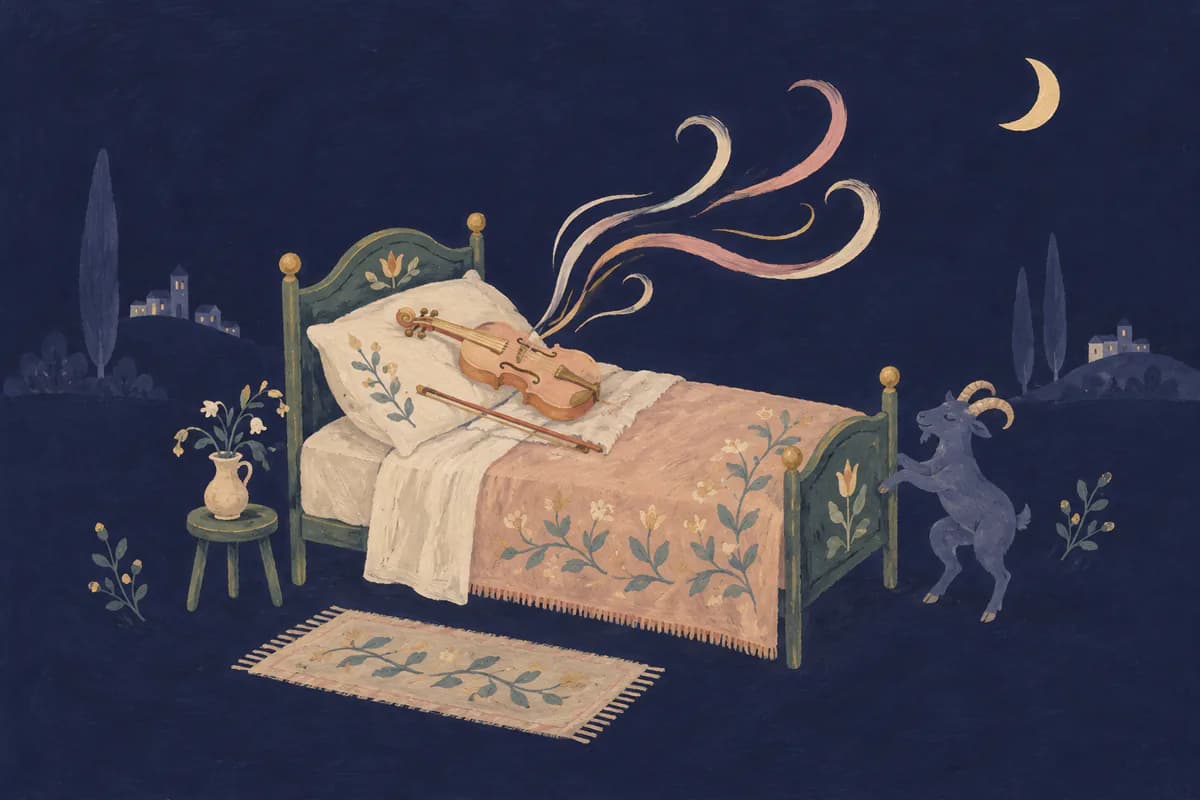
The violinist and composer Giuseppe Tartini told the French astronomer Lalande that one night he dreamed he had made a pact with the devil, who promised to serve him. To test him, Tartini handed the devil his violin.
The devil played a sonata of such beauty that Tartini, overwhelmed, woke and grabbed his own violin to catch what he had heard. He wrote the piece that became known as the Devil's Trill, but said it was far below what he had heard in the dream.
- Lalande 1769
De onde vem a história
The story reaches us through Lalande's travel book, Voyage d'un François en Italie (1769), which retells what Tartini told him near the end of his long life. Lalande dates the dream to 1713, when Tartini was about twenty-one.
The sonata, in G minor, was not published during Tartini's lifetime, and its famous name comes from the story rather than from the manuscript.
Como foi interpretado
Pesquisa
Tartini's sense that the dream music was better than anything he could write afterwards is a common experience. Dream researchers note that emotion in dreams is often intense while memory for detail is poor, so what survives waking is the feeling of brilliance rather than the notes themselves.
- Barrett 2001
- Zadra & Stickgold 2021
Perguntas para seus próprios sonhos
- Have you ever dreamed of something more beautiful than you could reproduce awake?
- What would you be tempted to trade for a talent you admire?
- Which of your own gifts do you sometimes treat as if they came from somewhere else?
Teve um sonho que marcou você?
Quero contar meu sonhoFontes
Todas as interpretações desta página vêm destas obras. Ainda há referências de páginas que não foram conferidas; elas estão sinalizadas.
Joseph Jérôme Lefrançois de Lalande (1769). Voyage d'un François en Italie, fait dans les années 1765 & 1766. Venice and Paris.
domínio público
- Local da citação: account of Tartini, Padua (referência ainda não conferida)
- Local da citação: account of Tartini (referência ainda não conferida)
Retells Tartini's dream as Tartini told it to the author; second-hand.
Deirdre Barrett (2001). The Committee of Sleep. New York: Crown.
citado, não reproduzido
- Local da citação: chapters on music (referência ainda não conferida)
Harvard psychologist on dreams and creative problem solving, with historical examples.
Antonio Zadra, Robert Stickgold (2021). When Brains Dream: Exploring the Science and Mystery of Sleep. New York: W. W. Norton.
citado, não reproduzido
- Local da citação: on emotion and memory in dreams (referência ainda não conferida)
NEXTUP model: dreaming explores weak, unexpected associations between memories.