
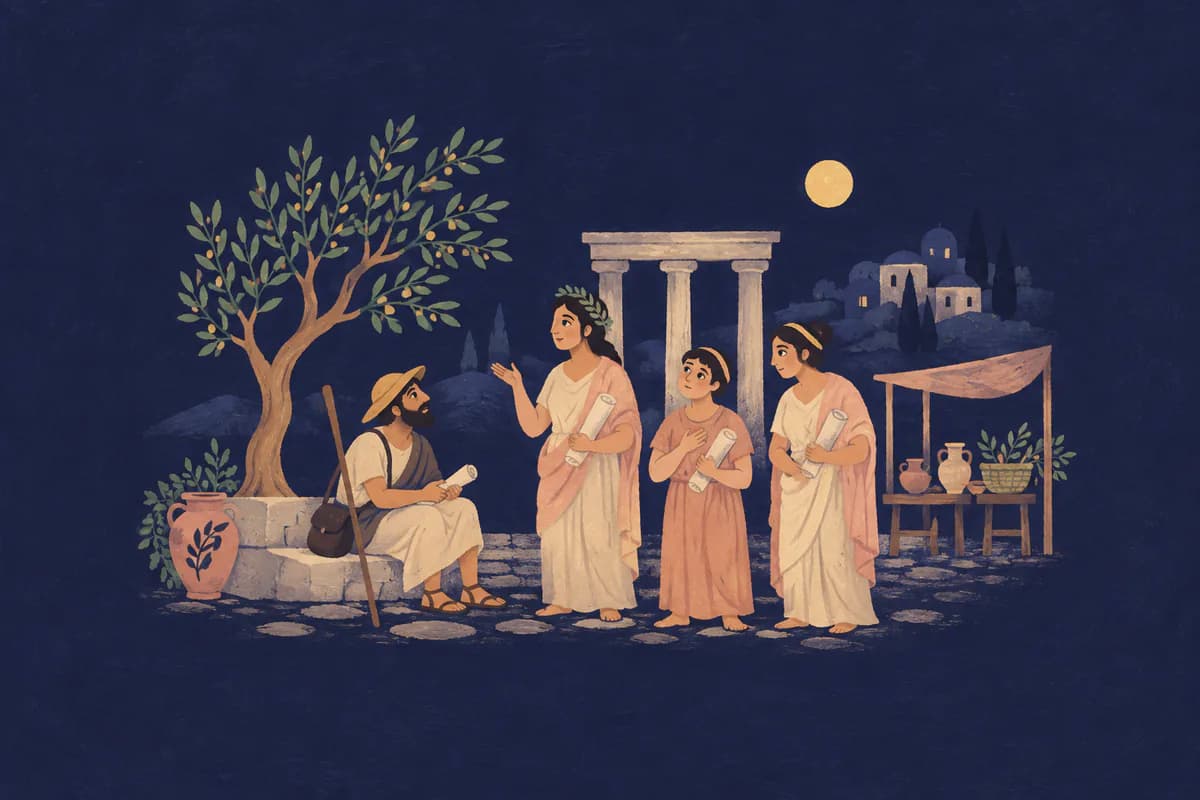
Dreamers recorded by Artemidorus2nd century CE
Artemidorus' casebook of dreams
The oldest surviving collection of real people's dreams, each paired with what the dreamer believed happened next.
Diese Seite ist für die Sprache Deutsch noch nicht verfügbar. Deshalb liest du die englische Version.
EntwurfDiese Seite wurde noch nicht redaktionell geprüft.
Der Traum
Nach den unten genannten Quellen in eigenen Worten nacherzählt, nicht zitiert.
Artemidorus of Daldis wrote the Oneirocritica, a manual of dream interpretation in five books. The fifth is different from the rest: instead of rules, it is a list of short case reports. Each one gives a dream and then the event that followed it, as reported to him.
He says he collected dreams by travelling through Greece, Asia Minor and Italy and by listening to many people, including the professional diviners of the marketplace whom others looked down on.
- Artemidorus 1644
Woher die Geschichte stammt
Artemidorus lived in the Roman empire in the second century. His work is the only complete ancient dream book to survive, and it is read today by historians of everyday life, because the dreams mention slaves, athletes, sailors, family quarrels and money worries.
Book V was meant as evidence that his method worked. Because only dreams that seemed to come true were likely to be remembered and passed on, the collection shows how people understood dreams, not that dreams predict events.
Wie der Traum gedeutet wurde
Klassische Texte
Artemidorus insisted that the same image means different things for different dreamers: their work, age, health and circumstances all mattered. That attention to the individual dreamer is the part of his method that still feels modern.
- Artemidorus 1644
Geschichte
A casebook of dreams that came true has a built-in bias: dreams that were followed by nothing notable were forgotten. We read Book V as a record of people's hopes and fears in the second century, and we do not use it to predict anything.
Fragen zu deinen eigenen Träumen
- Which details of your own life would someone need to know to understand your dream?
- Do you remember dreams more when something happens afterwards?
- If you kept a casebook of your dreams for a month, what patterns might appear?
Symbole in diesem Traum
Hattest du einen Traum, der dir im Gedächtnis geblieben ist?
Meinen Traum erzählenQuellen
Jede Deutung auf dieser Seite stammt aus diesen Werken. Noch sind nicht alle Seitenangaben geprüft. Ausstehende Prüfungen sind gekennzeichnet.
Artemidorus of Daldis (1644). The Interpretation of Dreams (Oneirocritica), in five books, übersetzt von Robert Wood. London.
erstmals veröffentlicht: 2nd century CE
gemeinfrei
- Fundstelle: Book V (Fundstelle noch nicht geprüft)
- Fundstelle: Book I, introduction; Book V (Fundstelle noch nicht geprüft)
Greek dream manual from the Roman era. We paraphrase the public-domain Wood translation (1644). Modern translations (White 1975, Harris-McCoy 2012, Hammond 2020) are copyrighted and only cited.