
Flood im Traum: Was es bedeuten kann
- Angst und Gefahr
- Natur
Diese Seite ist für die Sprache Deutsch noch nicht verfügbar. Deshalb liest du die englische Version.
EntwurfDiese Seite wurde noch nicht redaktionell geprüft.
Die kurze Antwort
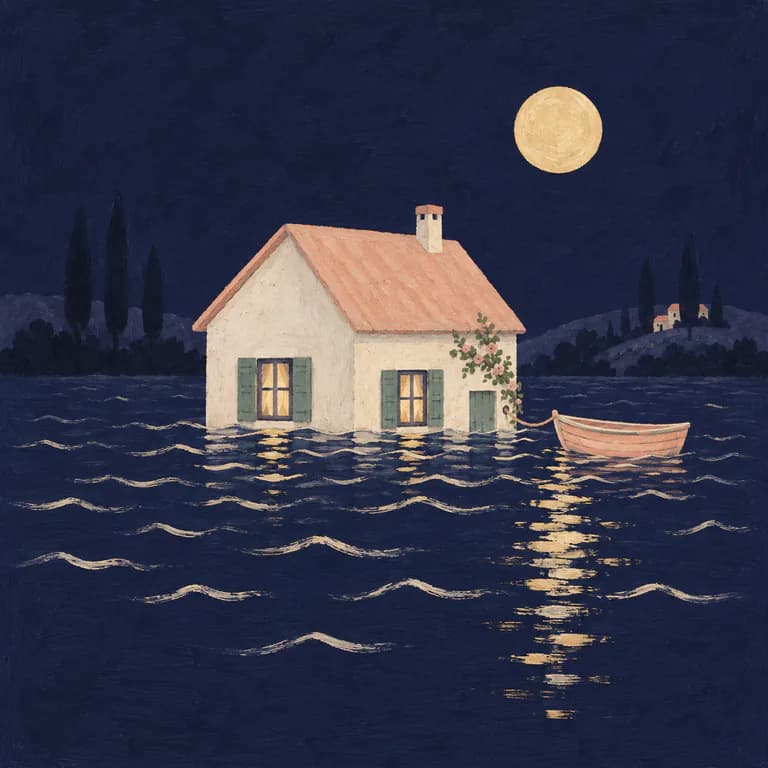
A flood is water where it should not be, rising faster than you can move. Many dreamers connect it with feeling overwhelmed by emotion, work or events.
Dein Traum ist ganz persönlich
Erzähl ihn so, wie du dich erinnerst. Du erhältst eine Deutung zu deinem Traum und deinem Leben, keinen Lexikoneintrag.
Wege zur Deutung
Psychologie und Forschung
ForschungFloods and tidal waves appear among the natural disaster themes that people report in surveys of typical dreams. On the continuity view, rising water is a vivid picture of being overwhelmed: tasks piling up, feelings that are hard to hold back, or news that spreads into every part of life. If you have lived through a real flood, these dreams can be part of how the mind processes that fear.
- Nielsen et al. 2003
- Domhoff 2001
- Levin & Nielsen 2007
Volkstümliche Überlieferung
Tradition, keine WissenschaftTradition: American popular dream books, around 1900
Miller's 1901 dream dictionary read floods as a sign of trouble and loss, and clear, calm water as better fortune. We report it as one old tradition's reading, not a forecast.
- Miller 1901
Fragen an dich selbst
- What in your life feels like it is rising faster than you can manage?
- Did you find high ground, and did you help anyone else reach it?
- What feeling have you been holding back that might need somewhere to go?
Verwandte Symbole
Quellen
Jede Deutung auf dieser Seite stammt aus diesen Werken. Noch sind nicht alle Seitenangaben geprüft. Ausstehende Prüfungen sind gekennzeichnet.
Tore A. Nielsen, Antonio L. Zadra, Valérie Simard, Sébastien Saucier, Philippe Stenstrom, Carlyle Smith, Don Kuiken (2003). The typical dreams of Canadian university students. Dreaming 13(4): 211-235.
als Quelle angeführt, nicht vervielfältigt
- Fundstelle: typical dreams questionnaire, results (Fundstelle noch nicht geprüft)
Survey of how many people report having had common dream themes (being chased, falling, teeth, flying, exams, nakedness and others) at least once.
G. William Domhoff (2001). A New Neurocognitive Theory of Dreams. Dreaming 11(1): 13-33.
als Quelle angeführt, nicht vervielfältigt
- Fundstelle: pp. 13-33 (dreams as simulations of personal concerns) (Fundstelle noch nicht geprüft)
Dreams as embodied simulations of personal concerns (the continuity view). The backbone of our psychology lens.
Ross Levin, Tore A. Nielsen (2007). Disturbed dreaming, posttraumatic stress disorder, and affect distress: A review and neurocognitive model. Psychological Bulletin 133(3): 482-528.
als Quelle angeführt, nicht vervielfältigt
- Fundstelle: pp. 482-528 (distressing dreams and emotional distress) (Fundstelle noch nicht geprüft)
Nightmares and distressing dreams in relation to fear processing and emotional distress.
Gustavus Hindman Miller (1901). What's in a Dream (later reissued as Ten Thousand Dreams Interpreted).
gemeinfrei
- Fundstelle: entry: Flood (Fundstelle noch nicht geprüft)
An American popular dream dictionary. Its entries are written as omens ("foretells"); we only report how people once read a symbol, never as a forecast.