
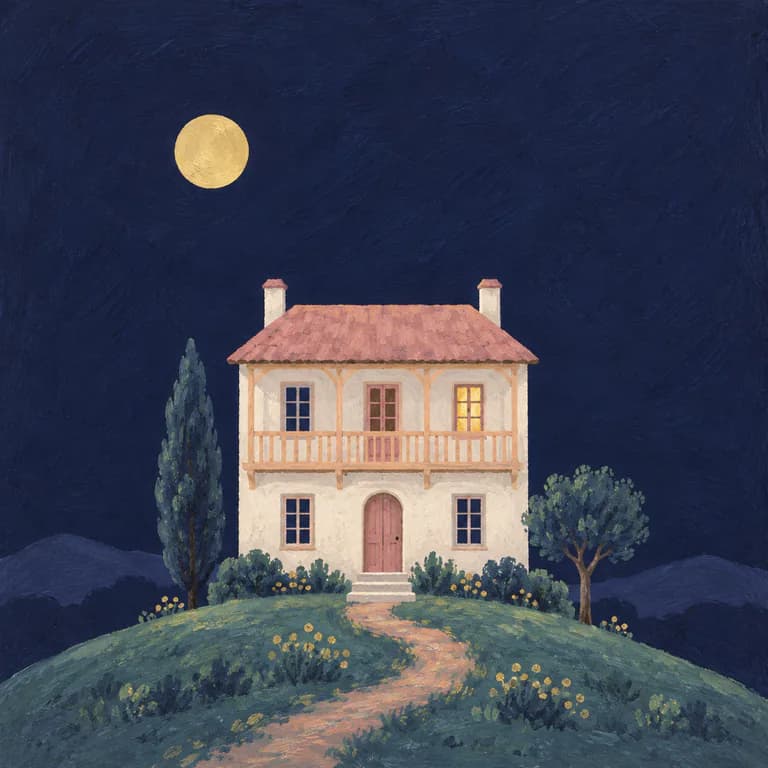
House im Traum: Was es bedeuten kann
- Orte
- Familie
Diese Seite ist für die Sprache Deutsch noch nicht verfügbar. Deshalb liest du die englische Version.
EntwurfDiese Seite wurde noch nicht redaktionell geprüft.
Die kurze Antwort
Houses are the most common dream settings of all. A childhood home, a strange house or a newly discovered room can say a lot about belonging, the past and parts of life you are exploring.
Dein Traum ist ganz persönlich
Erzähl ihn so, wie du dich erinnerst. Du erhältst eine Deutung zu deinem Traum und deinem Leben, keinen Lexikoneintrag.
Wege zur Deutung
Psychologie und Forschung
ForschungDream content studies code settings, and familiar indoor places, homes above all, are among the most frequent. Continuity researchers note that returning to a childhood home often comes with thoughts about family, the past, or who you were then. Discovering extra rooms is a well-known dream motif that dreamers often describe as exciting, and it is commonly read as finding space or possibility in your life. The state of the house (cosy, crumbling, flooded, crowded) is usually more telling than the house itself.
- Hall & Van de Castle 1966
- Domhoff 2001
Volkstümliche Überlieferung
Tradition, keine WissenschaftTradition: American popular dream books, around 1900
Dream books around 1900 read a fine new house as a move to better circumstances and a ruined house as losses. We report this as folklore, not as a forecast.
- Miller 1901
Fragen an dich selbst
- Whose house was it, and when in your life did it belong?
- What state was it in, and does that match how your home life feels now?
- Was there a room you had not seen before? What might it stand for?
Verwandte Symbole
Quellen
Jede Deutung auf dieser Seite stammt aus diesen Werken. Noch sind nicht alle Seitenangaben geprüft. Ausstehende Prüfungen sind gekennzeichnet.
Calvin S. Hall, Robert L. Van de Castle (1966). The Content Analysis of Dreams. New York: Appleton-Century-Crofts.
als Quelle angeführt, nicht vervielfältigt
- Fundstelle: coding categories: settings (Fundstelle noch nicht geprüft)
The standard coding system for dream content (characters, social interactions, misfortunes, emotions, settings, objects) and its normative sample.
G. William Domhoff (2001). A New Neurocognitive Theory of Dreams. Dreaming 11(1): 13-33.
als Quelle angeführt, nicht vervielfältigt
- Fundstelle: pp. 13-33 (dreams as simulations of personal concerns) (Fundstelle noch nicht geprüft)
Dreams as embodied simulations of personal concerns (the continuity view). The backbone of our psychology lens.
Gustavus Hindman Miller (1901). What's in a Dream (later reissued as Ten Thousand Dreams Interpreted).
gemeinfrei
- Fundstelle: entry: House (Fundstelle noch nicht geprüft)
An American popular dream dictionary. Its entries are written as omens ("foretells"); we only report how people once read a symbol, never as a forecast.