
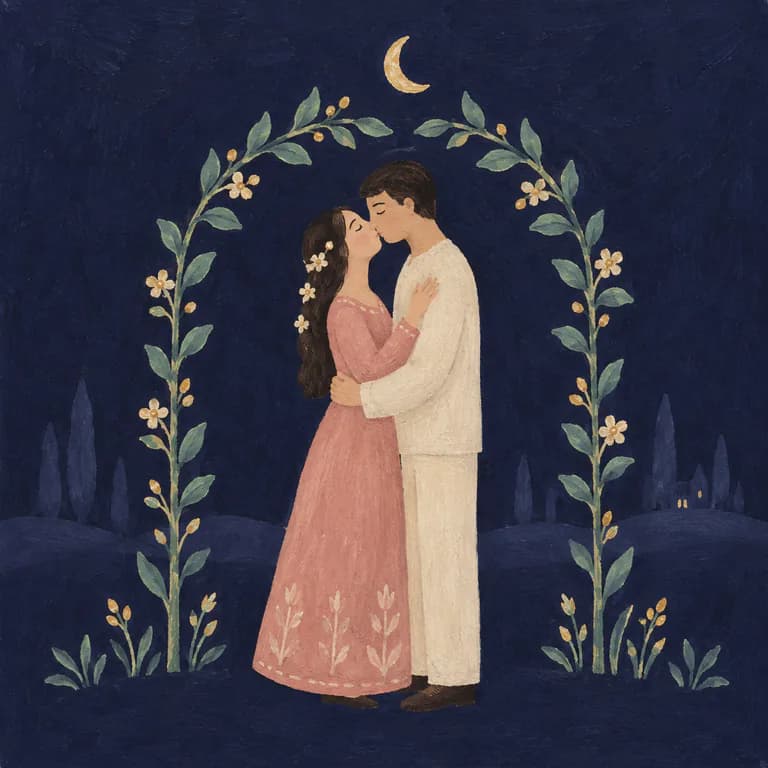
Kiss im Traum: Was es bedeuten kann
- Liebe und Beziehungen
- Körper
Diese Seite ist für die Sprache Deutsch noch nicht verfügbar. Deshalb liest du die englische Version.
EntwurfDiese Seite wurde noch nicht redaktionell geprüft.
Die kurze Antwort
A dream kiss can be about desire, affection, closeness or simply a mind replaying the people it thinks about. Kissing someone unexpected is common and does not mean you secretly want them.
Dein Traum ist ganz persönlich
Erzähl ihn so, wie du dich erinnerst. Du erhältst eine Deutung zu deinem Traum und deinem Leben, keinen Lexikoneintrag.
Wege zur Deutung
Psychologie und Forschung
ForschungFriendly and sexual interactions are standard categories in dream content research, and the continuity view links them to the people and feelings on our minds. Dreams also connect memories loosely, so a kiss with a friend, a colleague or a stranger may be the brain testing an unusual association rather than revealing a hidden wish. How the kiss felt is the part worth noticing.
- Hall & Van de Castle 1966
- Domhoff 2001
- Zadra & Stickgold 2021
Klassische Texte
GeschichteFreud held that dreams fulfil wishes, and a kiss is one of the plainest examples. He also argued that wishes are often disguised, so the person in the dream may stand for someone else. Later research does not support his idea that every dream is a wish.
- Freud 1913
Volkstümliche Überlieferung
Tradition, keine WissenschaftTradition: American popular dream books, around 1900
Miller's 1901 dream dictionary read kisses by their setting and partner, taking a kiss in the dark as a sign of risk and an affectionate family kiss as a good sign. These were popular readings of their time, not predictions.
- Miller 1901
Fragen an dich selbst
- How did the kiss feel: warm, awkward, exciting, wrong?
- What quality does this person have that you want more of in your life?
- Is there closeness you are missing right now?
Verwandte Symbole
Quellen
Jede Deutung auf dieser Seite stammt aus diesen Werken. Noch sind nicht alle Seitenangaben geprüft. Ausstehende Prüfungen sind gekennzeichnet.
Calvin S. Hall, Robert L. Van de Castle (1966). The Content Analysis of Dreams. New York: Appleton-Century-Crofts.
als Quelle angeführt, nicht vervielfältigt
- Fundstelle: coding categories: friendliness and sexuality (Fundstelle noch nicht geprüft)
The standard coding system for dream content (characters, social interactions, misfortunes, emotions, settings, objects) and its normative sample.
G. William Domhoff (2001). A New Neurocognitive Theory of Dreams. Dreaming 11(1): 13-33.
als Quelle angeführt, nicht vervielfältigt
- Fundstelle: pp. 13-33 (dreams as simulations of personal concerns) (Fundstelle noch nicht geprüft)
Dreams as embodied simulations of personal concerns (the continuity view). The backbone of our psychology lens.
Antonio Zadra, Robert Stickgold (2021). When Brains Dream: Exploring the Science and Mystery of Sleep. New York: W. W. Norton.
als Quelle angeführt, nicht vervielfältigt
- Fundstelle: the NEXTUP model (Fundstelle noch nicht geprüft)
NEXTUP model: dreaming explores weak, unexpected associations between memories.
Sigmund Freud (1913). The Interpretation of Dreams, übersetzt von A. A. Brill. New York: Macmillan.
erstmals veröffentlicht: 1900
gemeinfrei
- Fundstelle: Ch. III (the dream as the fulfilment of a wish) (Fundstelle noch nicht geprüft)
First English translation, of the third German edition. Public domain; scholars consider it looser than the later Strachey translation, which is copyrighted.
Gustavus Hindman Miller (1901). What's in a Dream (later reissued as Ten Thousand Dreams Interpreted).
gemeinfrei
- Fundstelle: entry: Kiss (Fundstelle noch nicht geprüft)
An American popular dream dictionary. Its entries are written as omens ("foretells"); we only report how people once read a symbol, never as a forecast.