
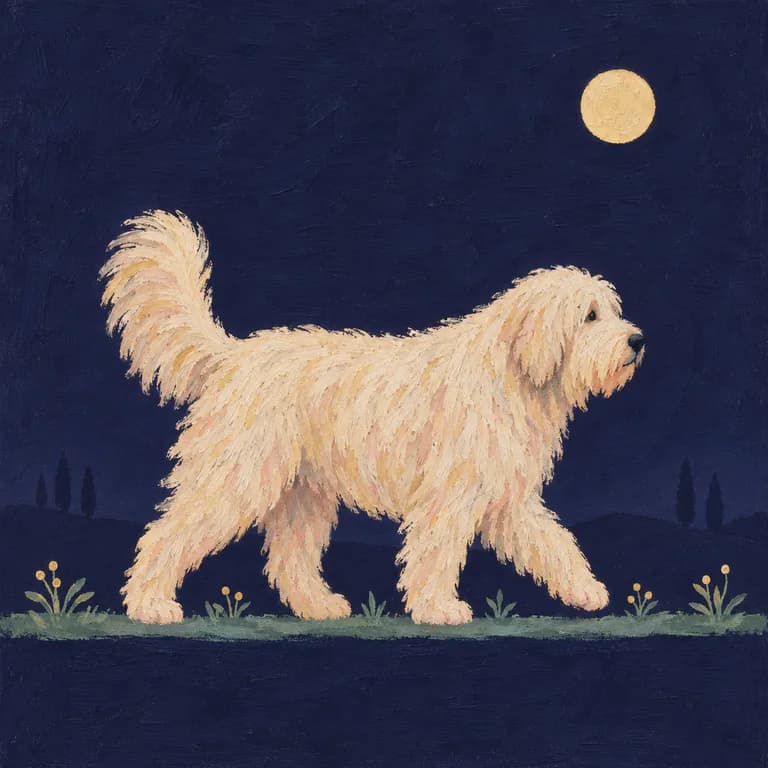
Dog in dreams: what it can mean
- Animals
- Love and relationships
DraftAn editor has not reviewed this page yet.
The short answer
Dogs in dreams usually take their meaning from your relationship with dogs and with loyalty. A friendly dog and a biting dog tell very different stories.
Your dream is not everyone's
Tell it the way you remember it. You get a reading about your dream and your life, not a dictionary entry.
Three ways to read it
Psychology and research
ResearchAnimals are a distinct category in the Hall and Van de Castle system, and how animals behave in a dream, friendly or aggressive, is part of what researchers code. A dog you love may simply appear because it is part of your daily life, which is the continuity view at its most literal. Unknown dogs are often linked to loyalty, protection or threat: someone who has your back, or someone you expect to turn on you. A dog bite often comes up in dreams about betrayal or a sharp conflict.
- Hall & Van de Castle 1966
- Domhoff 2001
Folk tradition
Tradition, not scienceTradition: American popular dream books, around 1900
Dream books around 1900 read a friendly dog as faithful friends and a vicious dog as enemies. We report this as tradition, not prediction.
- Miller 1901
Questions to ask yourself
- Was the dog protecting you, threatening you or just there?
- Who in your life feels loyal right now, and who feels like they might bite?
- Is there a part of you that is on guard or ready to defend something?
Related symbols
Sources
Every reading on this page comes from these works. Page references have not all been checked yet; those still waiting are marked.
Calvin S. Hall, Robert L. Van de Castle (1966). The Content Analysis of Dreams. New York: Appleton-Century-Crofts.
cited, not reproduced
- Cited at: coding categories: animals (reference not yet checked)
The standard coding system for dream content (characters, social interactions, misfortunes, emotions, settings, objects) and its normative sample.
G. William Domhoff (2001). A New Neurocognitive Theory of Dreams. Dreaming 11(1): 13-33.
cited, not reproduced
- Cited at: pp. 13-33 (dreams as simulations of personal concerns) (reference not yet checked)
Dreams as embodied simulations of personal concerns (the continuity view). The backbone of our psychology lens.
Gustavus Hindman Miller (1901). What's in a Dream (later reissued as Ten Thousand Dreams Interpreted).
public domain
- Cited at: entry: Dog (reference not yet checked)
An American popular dream dictionary. Its entries are written as omens ("foretells"); we only report how people once read a symbol, never as a forecast.