
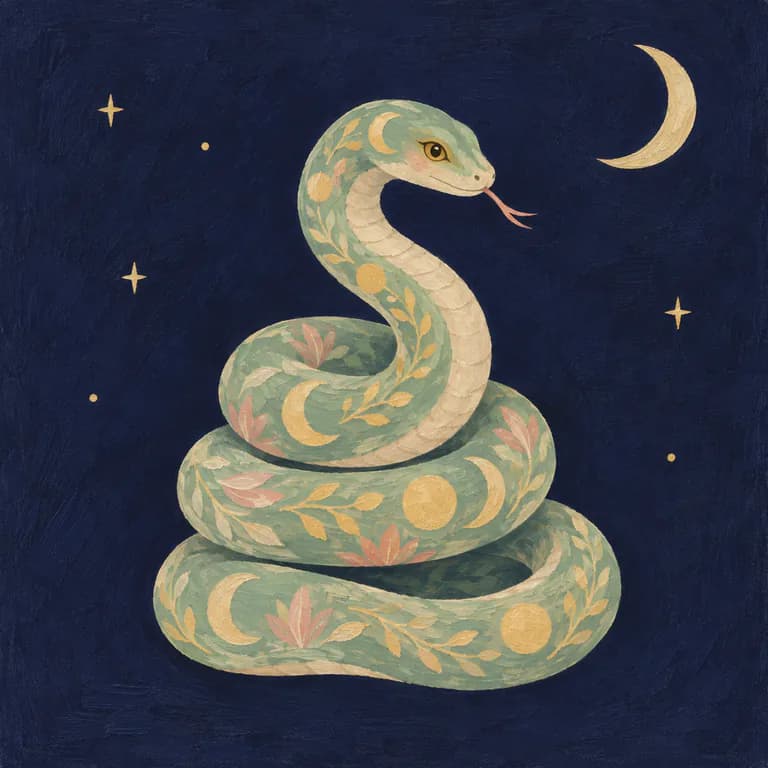
Snake in dreams: what it can mean
- Animals
- Fear and danger
- Change
DraftAn editor has not reviewed this page yet.
The short answer
Snakes are one of the most searched dream images worldwide. What they mean for you depends on how the snake behaved and how you felt: fear, fascination and calm point to very different stories.
Your dream is not everyone's
Tell it the way you remember it. You get a reading about your dream and your life, not a dictionary entry.
Three ways to read it
Psychology and research
ResearchAnimals appear often in dreams, and the Hall and Van de Castle coding system counts them as their own category. A snake is a strong, fast image for something that feels unpredictable, hidden or able to hurt you, but for some dreamers it stands for renewal or quiet power, the way a snake sheds its skin. Threat simulation theory, which is contested, proposes that dreams rehearse danger, which would explain why a sudden bite feels so vivid. A continuity reading asks who or what in your waking life you do not fully trust, or what change you are circling around.
- Hall & Van de Castle 1966
- Revonsuo 2000
- Domhoff 2001
Classic texts
HistoryArtemidorus discussed serpents among the animals of dreams and read them in more than one direction: as a sign of power or of a powerful person, and also as a hidden enemy or an illness. As usual he weighed the dreamer's situation and what the snake did before choosing a reading.
- Artemidorus 1644
Folk tradition
Tradition, not scienceTradition: American popular dream books, around 1900
Early twentieth-century dream dictionaries in English generally read serpents as a warning of enemies or of trouble, often with extra detail for being bitten or killing the snake. This is a historical way of reading the image, not a prediction.
- Miller 1901
Questions to ask yourself
- Did the snake threaten you, ignore you or let you near it? Which of those feels familiar in your life?
- Is there someone or something you feel you have to keep an eye on at the moment?
- Is anything in you ready to be shed, like old skin?
Related symbols
Sources
Every reading on this page comes from these works. Page references have not all been checked yet; those still waiting are marked.
Calvin S. Hall, Robert L. Van de Castle (1966). The Content Analysis of Dreams. New York: Appleton-Century-Crofts.
cited, not reproduced
- Cited at: coding categories: animals (reference not yet checked)
The standard coding system for dream content (characters, social interactions, misfortunes, emotions, settings, objects) and its normative sample.
Antti Revonsuo (2000). The reinterpretation of dreams: An evolutionary hypothesis of the function of dreaming. Behavioral and Brain Sciences 23(6): 877-901.
cited, not reproducedcontested theory
- Cited at: pp. 877-901 (threat simulation theory) (reference not yet checked)
Threat simulation theory: dreams as rehearsal for danger. Influential but contested; presented as one theory among several.
G. William Domhoff (2001). A New Neurocognitive Theory of Dreams. Dreaming 11(1): 13-33.
cited, not reproduced
- Cited at: pp. 13-33 (dreams as simulations of personal concerns) (reference not yet checked)
Dreams as embodied simulations of personal concerns (the continuity view). The backbone of our psychology lens.
Artemidorus of Daldis (1644). The Interpretation of Dreams (Oneirocritica), in five books, translated by Robert Wood. London.
first published 2nd century CE
public domain
- Cited at: Book II, on serpents (reference not yet checked)
Greek dream manual from the Roman era. We paraphrase the public-domain Wood translation (1644). Modern translations (White 1975, Harris-McCoy 2012, Hammond 2020) are copyrighted and only cited.
Gustavus Hindman Miller (1901). What's in a Dream (later reissued as Ten Thousand Dreams Interpreted).
public domain
- Cited at: entry: Serpents (reference not yet checked)
An American popular dream dictionary. Its entries are written as omens ("foretells"); we only report how people once read a symbol, never as a forecast.