
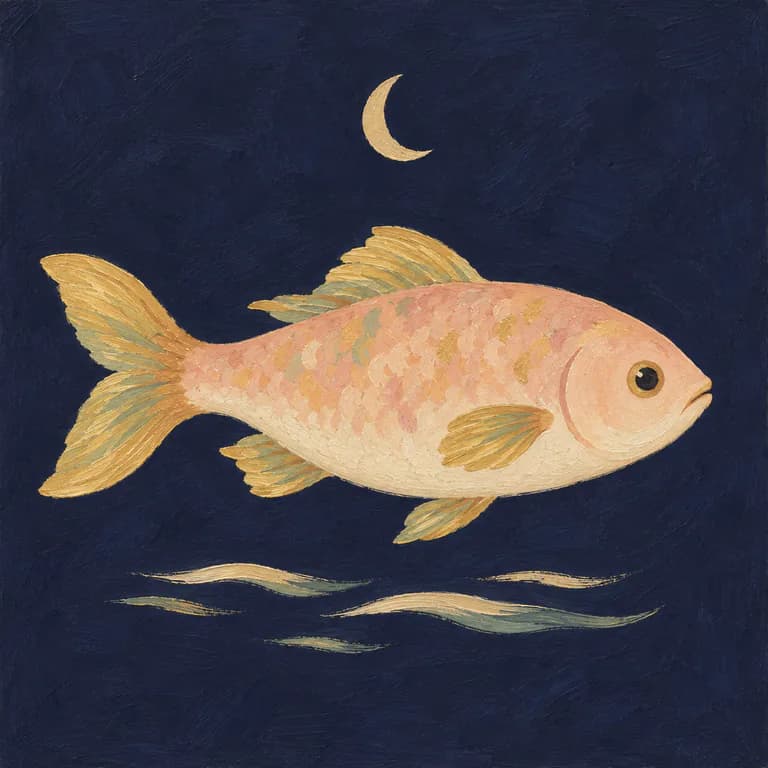
Fish in dreams: what it can mean
- Animals
- Nature
- New beginnings
DraftAn editor has not reviewed this page yet.
The short answer
Fish are a very common dream image in several cultures, where tradition often ties them to pregnancy or abundance. Psychologically, catching or losing a fish often follows how you feel about an opportunity.
Your dream is not everyone's
Tell it the way you remember it. You get a reading about your dream and your life, not a dictionary entry.
Three ways to read it
Psychology and research
ResearchFish live in water, so they share its emotional colour: clear or murky, calm or rough. A continuity reading might connect catching a fish with getting hold of an opportunity, and a fish slipping away with something you could not keep. In some families and cultures, dreaming of fish is widely believed to announce a pregnancy, and hearing that belief can itself shape what people dream and remember.
- Domhoff 2001
- Zadra & Stickgold 2021
Folk tradition
Tradition, not scienceTradition: American popular dream books, around 1900
Dream books around 1900 read fish in clear water as favour from powerful people and dead fish as loss. In Russian and several other folk traditions, fish dreams are also widely linked with pregnancy. These are beliefs, not predictions.
- Miller 1901
Questions to ask yourself
- Did you catch the fish, watch it or lose it?
- What opportunity or new beginning is on your mind?
- What did the water around the fish look like?
Related symbols
Sources
Every reading on this page comes from these works. Page references have not all been checked yet; those still waiting are marked.
G. William Domhoff (2001). A New Neurocognitive Theory of Dreams. Dreaming 11(1): 13-33.
cited, not reproduced
- Cited at: pp. 13-33 (dreams as simulations of personal concerns) (reference not yet checked)
Dreams as embodied simulations of personal concerns (the continuity view). The backbone of our psychology lens.
Antonio Zadra, Robert Stickgold (2021). When Brains Dream: Exploring the Science and Mystery of Sleep. New York: W. W. Norton.
cited, not reproduced
- Cited at: the NEXTUP model (reference not yet checked)
NEXTUP model: dreaming explores weak, unexpected associations between memories.
Gustavus Hindman Miller (1901). What's in a Dream (later reissued as Ten Thousand Dreams Interpreted).
public domain
- Cited at: entry: Fish (reference not yet checked)
An American popular dream dictionary. Its entries are written as omens ("foretells"); we only report how people once read a symbol, never as a forecast.