
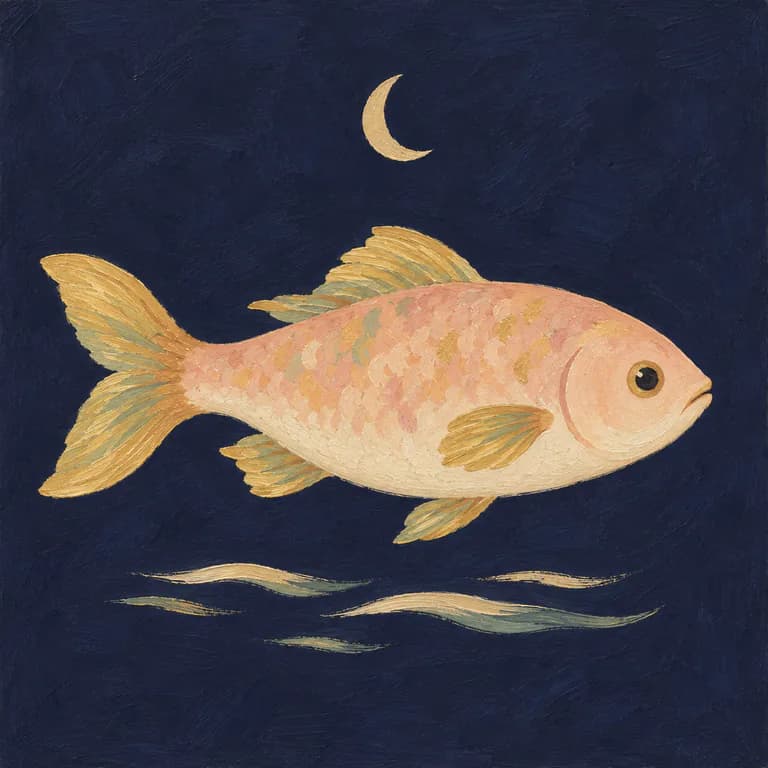
Fish nos sonhos: o que pode significar
- Animais
- Natureza
- Novos começos
Esta página ainda não está disponível no idioma Português (Brasil), por isso você está lendo a versão em inglês.
RascunhoEsta página ainda não foi revisada por um editor.
A resposta breve
Fish are a very common dream image in several cultures, where tradition often ties them to pregnancy or abundance. Psychologically, catching or losing a fish often follows how you feel about an opportunity.
Seu sonho é só seu
Conte do jeito que você lembra. Você recebe uma interpretação sobre seu sonho e sua vida, não um verbete de dicionário.
Três formas de interpretar
Psicologia e pesquisa
PesquisaFish live in water, so they share its emotional colour: clear or murky, calm or rough. A continuity reading might connect catching a fish with getting hold of an opportunity, and a fish slipping away with something you could not keep. In some families and cultures, dreaming of fish is widely believed to announce a pregnancy, and hearing that belief can itself shape what people dream and remember.
- Domhoff 2001
- Zadra & Stickgold 2021
Tradição popular
Tradição, não ciênciaTradição: American popular dream books, around 1900
Dream books around 1900 read fish in clear water as favour from powerful people and dead fish as loss. In Russian and several other folk traditions, fish dreams are also widely linked with pregnancy. These are beliefs, not predictions.
- Miller 1901
Perguntas para você refletir
- Did you catch the fish, watch it or lose it?
- What opportunity or new beginning is on your mind?
- What did the water around the fish look like?
Símbolos relacionados
Fontes
Todas as interpretações desta página vêm destas obras. Ainda há referências de páginas que não foram conferidas; elas estão sinalizadas.
G. William Domhoff (2001). A New Neurocognitive Theory of Dreams. Dreaming 11(1): 13-33.
citado, não reproduzido
- Local da citação: pp. 13-33 (dreams as simulations of personal concerns) (referência ainda não conferida)
Dreams as embodied simulations of personal concerns (the continuity view). The backbone of our psychology lens.
Antonio Zadra, Robert Stickgold (2021). When Brains Dream: Exploring the Science and Mystery of Sleep. New York: W. W. Norton.
citado, não reproduzido
- Local da citação: the NEXTUP model (referência ainda não conferida)
NEXTUP model: dreaming explores weak, unexpected associations between memories.
Gustavus Hindman Miller (1901). What's in a Dream (later reissued as Ten Thousand Dreams Interpreted).
domínio público
- Local da citação: entry: Fish (referência ainda não conferida)
An American popular dream dictionary. Its entries are written as omens ("foretells"); we only report how people once read a symbol, never as a forecast.