
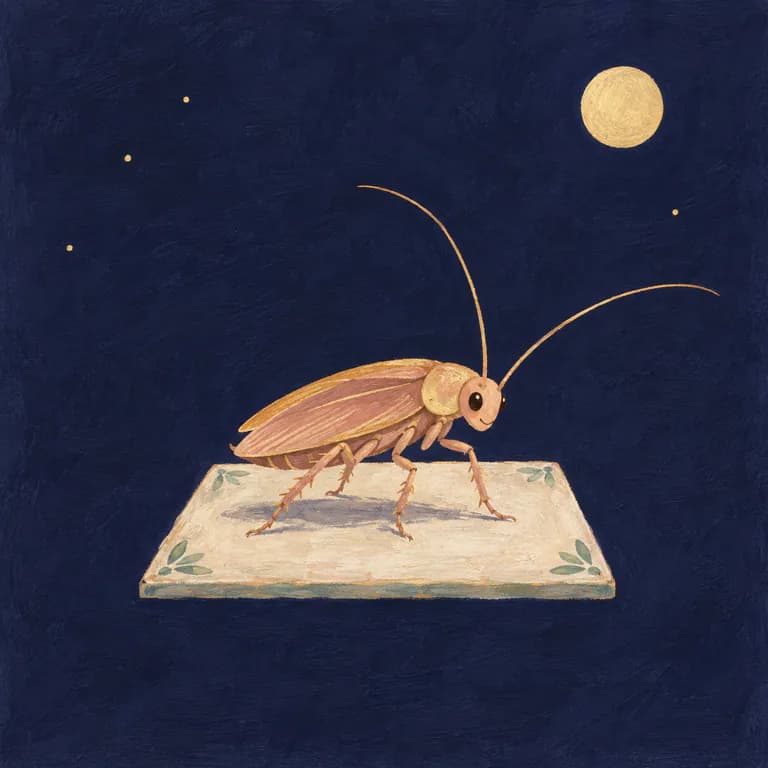
Cockroach en sueños: qué puede significar
- Animales
- Miedo y peligro
- Lugares
Esta página aún no está disponible en el idioma que elegiste (Español), así que estás viendo la versión en inglés.
BorradorEsta página aún no ha sido revisada por un editor.
La respuesta breve
Cockroaches bring disgust and the sense that something keeps surviving no matter what. Many dreamers connect them with a problem they cannot clean away, or with a space that no longer feels like theirs.
Tu sueño es personal
Cuéntalo tal como lo recuerdas. Recibirás una interpretación sobre tu sueño y tu vida, no una entrada de diccionario.
Tres formas de interpretarlo
Psicología e investigación
InvestigaciónInsects are among the typical dream themes people report, and disgust is one of the emotions researchers code in dream reports. The continuity view reads the feeling as the link to waking life: something persistent, unwanted or hidden in the corners. It can also be literal, since a real infestation or a new home easily shows up at night.
- Nielsen et al. 2003
- Hall & Van de Castle 1966
- Domhoff 2001
Preguntas para hacerte
- What problem in your life keeps coming back after you think it is gone?
- Where were the cockroaches, and whose space was it?
- What would it take to feel clean or settled again?
Símbolos relacionados
Fuentes
Todas las interpretaciones de esta página se basan en estas obras. Aún no se han comprobado todas las referencias a páginas; las pendientes están marcadas.
Tore A. Nielsen, Antonio L. Zadra, Valérie Simard, Sébastien Saucier, Philippe Stenstrom, Carlyle Smith, Don Kuiken (2003). The typical dreams of Canadian university students. Dreaming 13(4): 211-235.
citado, no reproducido
- Ubicación de la cita: typical dreams questionnaire, results (referencia aún sin comprobar)
Survey of how many people report having had common dream themes (being chased, falling, teeth, flying, exams, nakedness and others) at least once.
Calvin S. Hall, Robert L. Van de Castle (1966). The Content Analysis of Dreams. New York: Appleton-Century-Crofts.
citado, no reproducido
- Ubicación de la cita: coding categories: animals and emotions (referencia aún sin comprobar)
The standard coding system for dream content (characters, social interactions, misfortunes, emotions, settings, objects) and its normative sample.
G. William Domhoff (2001). A New Neurocognitive Theory of Dreams. Dreaming 11(1): 13-33.
citado, no reproducido
- Ubicación de la cita: pp. 13-33 (dreams as simulations of personal concerns) (referencia aún sin comprobar)
Dreams as embodied simulations of personal concerns (the continuity view). The backbone of our psychology lens.