
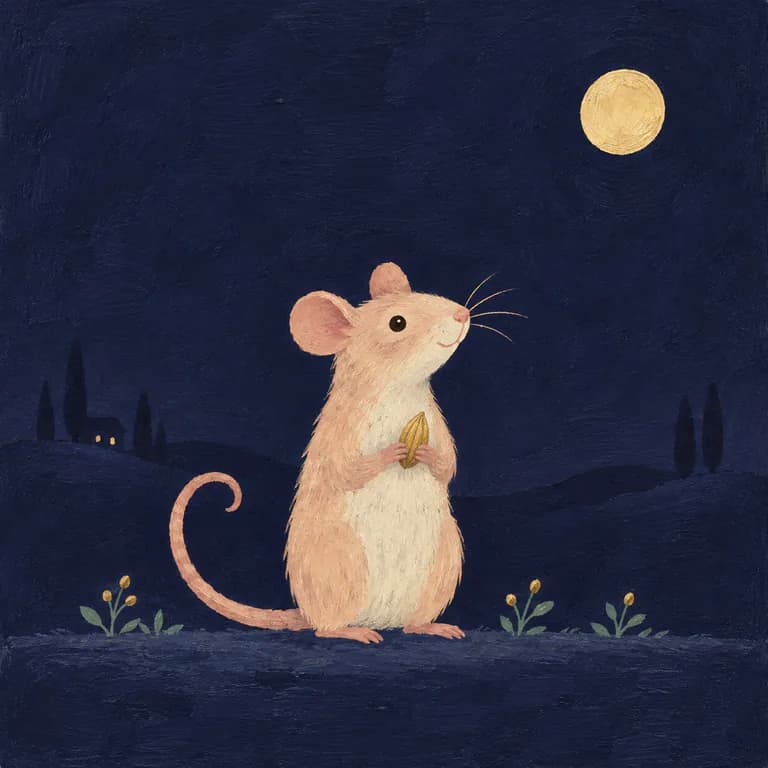
Rat en sueños: qué puede significar
- Animales
- Miedo y peligro
- Lugares
Esta página aún no está disponible en el idioma que elegiste (Español), así que estás viendo la versión en inglés.
BorradorEsta página aún no ha sido revisada por un editor.
La respuesta breve
Rats often bring disgust and a sense that something unwanted has got in. Many dreamers link them to a worry that feels small but persistent, or to someone they no longer trust.
Tu sueño es personal
Cuéntalo tal como lo recuerdas. Recibirás una interpretación sobre tu sueño y tu vida, no una entrada de diccionario.
Tres formas de interpretarlo
Psicología e investigación
InvestigaciónResearchers who code dream content note both the animals that appear and the emotions attached to them. Disgust and unease are common with rats and mice, and on the continuity view that feeling is the thread back to waking life. Ask what has been gnawing at you: a hidden problem, a leak of money or energy, or a situation that feels contaminated.
- Hall & Van de Castle 1966
- Domhoff 2001
Textos clásicos
HistoriaArtemidorus read a mouse as a household servant, reasoning that it lives under the same roof and eats the same food as the family. For him the image was about the people close to the household and whether they could be trusted, a reminder that his readings were built on the dreamer's own circumstances.
- Artemidorus 1644
Tradición popular
Tradición, no cienciaTradición: American popular dream books, around 1900
Miller's 1901 dream dictionary read rats as a sign of being deceived or wronged by people nearby, and catching or killing them as getting the better of that trouble. This was a popular reading of its time, not a forecast.
- Miller 1901
Preguntas para hacerte
- What in your life feels like it is quietly eating away at something?
- Was the rat in your own space? What would it mean to you if something had got into your home?
- Is there someone you are unsure you can trust at the moment?
Símbolos relacionados
Fuentes
Todas las interpretaciones de esta página se basan en estas obras. Aún no se han comprobado todas las referencias a páginas; las pendientes están marcadas.
Calvin S. Hall, Robert L. Van de Castle (1966). The Content Analysis of Dreams. New York: Appleton-Century-Crofts.
citado, no reproducido
- Ubicación de la cita: coding categories: animals and emotions (referencia aún sin comprobar)
The standard coding system for dream content (characters, social interactions, misfortunes, emotions, settings, objects) and its normative sample.
G. William Domhoff (2001). A New Neurocognitive Theory of Dreams. Dreaming 11(1): 13-33.
citado, no reproducido
- Ubicación de la cita: pp. 13-33 (dreams as simulations of personal concerns) (referencia aún sin comprobar)
Dreams as embodied simulations of personal concerns (the continuity view). The backbone of our psychology lens.
Artemidorus of Daldis (1644). The Interpretation of Dreams (Oneirocritica), in five books, traducción de Robert Wood. London.
primera publicación: 2nd century CE
dominio público
- Ubicación de la cita: Book III, on the mouse (referencia aún sin comprobar)
Greek dream manual from the Roman era. We paraphrase the public-domain Wood translation (1644). Modern translations (White 1975, Harris-McCoy 2012, Hammond 2020) are copyrighted and only cited.
Gustavus Hindman Miller (1901). What's in a Dream (later reissued as Ten Thousand Dreams Interpreted).
dominio público
- Ubicación de la cita: entry: Rats (referencia aún sin comprobar)
An American popular dream dictionary. Its entries are written as omens ("foretells"); we only report how people once read a symbol, never as a forecast.