
René DescartesNight of 10 to 11 November 1619
Descartes' three dreams
On the night he believed he had found the foundations of a new science, the young Descartes had three dreams he took as a turning point in his life.
Esta página ainda não está disponível no idioma Português (Brasil), por isso você está lendo a versão em inglês.
RascunhoEsta página ainda não foi revisada por um editor.
O sonho
Recontado com nossas próprias palavras a partir das fontes abaixo, sem citação literal.
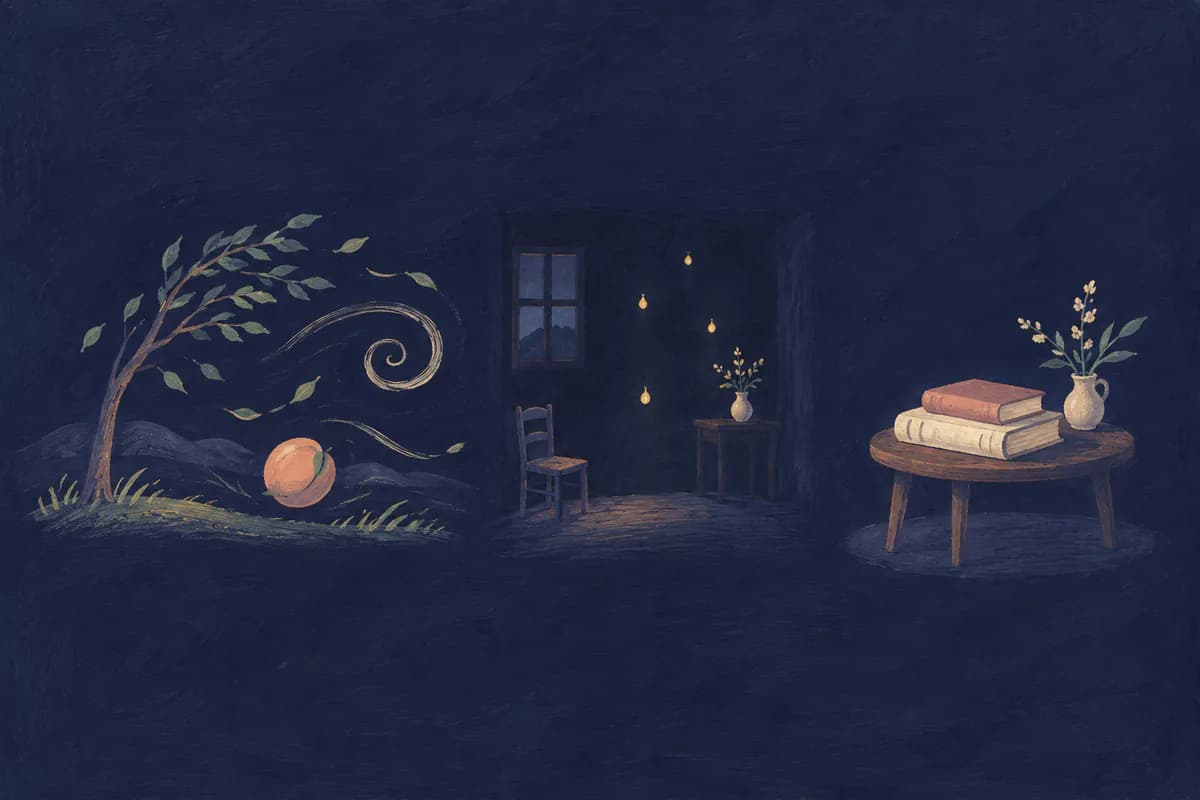
In the first dream, Descartes was frightened by phantoms and pushed along by a violent wind that spun him around as he tried to walk to a college chapel. Someone told him that an acquaintance had something to give him, which he took to be a melon from a foreign country. He woke with a pain in his side.
In the second, he heard a sharp noise like a thunderclap and, waking, saw sparks of fire scattered around his room. In the third, calmer dream he found two books on a table: a dictionary and an anthology of Latin poets. He opened the anthology at a line that asks, in Latin, "Quod vitae sectabor iter?" (What path in life shall I follow?). A stranger then showed him a poem beginning with the words "Est et Non" (It is and it is not).
- Baillet 1691
De onde vem a história
Descartes, then twenty-three, was in winter quarters in Germany as a volunteer soldier. According to his biographer, he had spent the day alone in a heated room and had become convinced he had discovered the foundations of a wonderful science.
We know the dreams only through Adrien Baillet's biography of 1691, which paraphrases a notebook of Descartes' that has since been lost. So the account is second-hand, written down some seventy years later, though from Descartes' own notes.
Como foi interpretado
História
According to Baillet, Descartes began interpreting the third dream while still dreaming. He read the dictionary as the sciences gathered together and the poetry anthology as philosophy and wisdom joined, and he took the whole night as a sign about his vocation. He vowed a pilgrimage in thanks.
- Baillet 1691
Pesquisa
From a continuity point of view, the dreams are almost literal: a young man, after a day of intense thinking about what to do with his life, dreams of being pushed off course, of a sudden shock, and finally of a book asking which path to follow. Dreams often pick up the question that matters most to us at that moment.
- Domhoff 2001
Perguntas para seus próprios sonhos
- What question about your own path is on your mind lately?
- Have you ever had a dream that felt like a turning point? What changed afterwards?
- If a stranger in your dream handed you a line of writing, what would you want it to say?
Símbolos neste sonho
Teve um sonho que marcou você?
Quero contar meu sonhoFontes
Todas as interpretações desta página vêm destas obras. Ainda há referências de páginas que não foram conferidas; elas estão sinalizadas.
Adrien Baillet (1691). La Vie de Monsieur Des-Cartes. Paris: Daniel Horthemels.
domínio público
- Local da citação: Vol. I, Book II, ch. 1 (referência ainda não conferida)
Two-volume biography. Our only account of Descartes' three dreams, paraphrased by Baillet from a notebook of Descartes' that is now lost.
G. William Domhoff (2001). A New Neurocognitive Theory of Dreams. Dreaming 11(1): 13-33.
citado, não reproduzido
- Local da citação: pp. 13-33 (referência ainda não conferida)
Dreams as embodied simulations of personal concerns (the continuity view). The backbone of our psychology lens.