
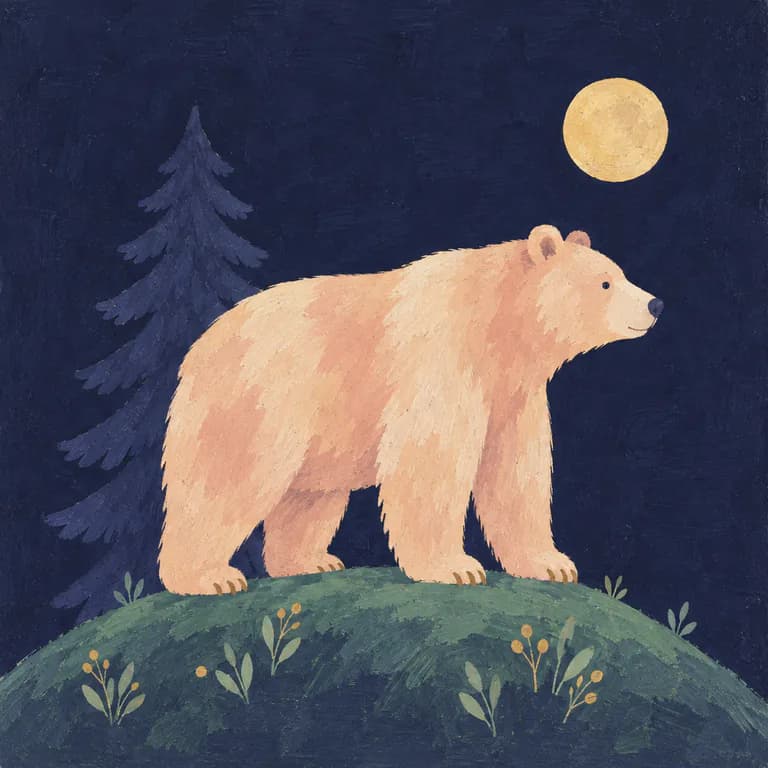
Bear nos sonhos: o que pode significar
- Animais
- Medo e perigo
- Natureza
Esta página ainda não está disponível no idioma Português (Brasil), por isso você está lendo a versão em inglês.
RascunhoEsta página ainda não foi revisada por um editor.
A resposta breve
A bear is powerful, protective and dangerous all at once. Many dreamers connect it with a strong person in their life, or with a force they fear might turn on them.
Seu sonho é só seu
Conte do jeito que você lembra. Você recebe uma interpretação sobre seu sonho e sua vida, não um verbete de dicionário.
Três formas de interpretar
Psicologia e pesquisa
PesquisaResearchers who code dream content find that wild animals often appear in threatening roles, and being chased or attacked is among the most commonly reported typical themes. Threat simulation theory, one contested account, reads such dreams as rehearsal for danger. The continuity view asks a more personal question: who or what in your life is big, unpredictable and hard to reason with?
- Hall & Van de Castle 1966
- Nielsen et al. 2003
- Revonsuo 2000
Textos clássicos
HistóriaArtemidorus read a bear as a woman, drawing on the Greek myth of Callisto, who was turned into a bear. It shows how his readings worked: through the stories and associations of his own culture rather than a universal code.
- Artemidorus 1644
Tradição popular
Tradição, não ciênciaTradição: American popular dream books, around 1900
Miller's 1901 dream dictionary read a bear as a sign of overwhelming competition, and killing one as getting free of difficulties. It is one old tradition, reported as history, not as a prediction.
- Miller 1901
Perguntas para você refletir
- Who in your life is powerful enough to protect you or to hurt you?
- Did you run, freeze, fight or try to calm the bear?
- What strength of your own might the bear stand for?
Símbolos relacionados
Fontes
Todas as interpretações desta página vêm destas obras. Ainda há referências de páginas que não foram conferidas; elas estão sinalizadas.
Calvin S. Hall, Robert L. Van de Castle (1966). The Content Analysis of Dreams. New York: Appleton-Century-Crofts.
citado, não reproduzido
- Local da citação: coding categories: animals and aggression (referência ainda não conferida)
The standard coding system for dream content (characters, social interactions, misfortunes, emotions, settings, objects) and its normative sample.
Tore A. Nielsen, Antonio L. Zadra, Valérie Simard, Sébastien Saucier, Philippe Stenstrom, Carlyle Smith, Don Kuiken (2003). The typical dreams of Canadian university students. Dreaming 13(4): 211-235.
citado, não reproduzido
- Local da citação: typical dreams questionnaire, results (referência ainda não conferida)
Survey of how many people report having had common dream themes (being chased, falling, teeth, flying, exams, nakedness and others) at least once.
Antti Revonsuo (2000). The reinterpretation of dreams: An evolutionary hypothesis of the function of dreaming. Behavioral and Brain Sciences 23(6): 877-901.
citado, não reproduzidoteoria contestada
- Local da citação: pp. 877-901 (threat simulation theory) (referência ainda não conferida)
Threat simulation theory: dreams as rehearsal for danger. Influential but contested; presented as one theory among several.
Artemidorus of Daldis (1644). The Interpretation of Dreams (Oneirocritica), in five books, tradução de Robert Wood. London.
primeira publicação: 2nd century CE
domínio público
- Local da citação: Book II, on wild animals (the bear) (referência ainda não conferida)
Greek dream manual from the Roman era. We paraphrase the public-domain Wood translation (1644). Modern translations (White 1975, Harris-McCoy 2012, Hammond 2020) are copyrighted and only cited.
Gustavus Hindman Miller (1901). What's in a Dream (later reissued as Ten Thousand Dreams Interpreted).
domínio público
- Local da citação: entry: Bear (referência ainda não conferida)
An American popular dream dictionary. Its entries are written as omens ("foretells"); we only report how people once read a symbol, never as a forecast.