
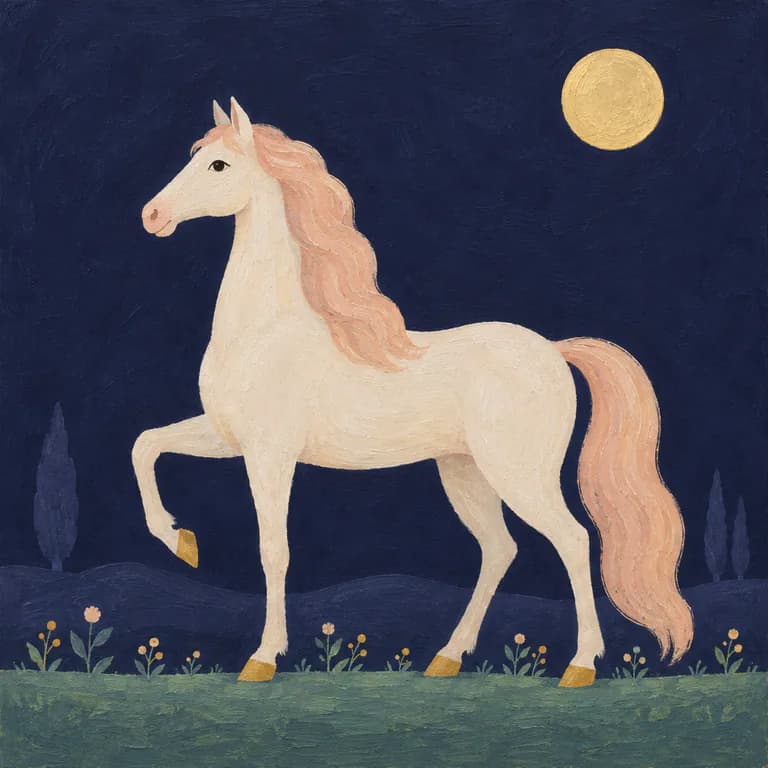
Horse nos sonhos: o que pode significar
- Animais
- Jornadas
Esta página ainda não está disponível no idioma Português (Brasil), por isso você está lendo a versão em inglês.
RascunhoEsta página ainda não foi revisada por um editor.
A resposta breve
Horses carry strength, speed and the question of control. Riding smoothly, being thrown or watching a horse run free are very different dreams, and the difference is usually the point.
Seu sonho é só seu
Conte do jeito que você lembra. Você recebe uma interpretação sobre seu sonho e sua vida, não um verbete de dicionário.
Três formas de interpretar
Psicologia e pesquisa
PesquisaAnimals are a regular part of dream content in the standard coding system used by researchers, and the continuity view suggests they borrow meaning from the dreamer's own experience with them. For one person a horse is a childhood riding lesson, for another a powerful animal they never quite trusted. Many people find the question of control useful: who is steering, you or the horse?
- Hall & Van de Castle 1966
- Domhoff 2001
Textos clássicos
HistóriaArtemidorus, the second century dream interpreter, read a horse partly through what it does for its rider: carrying, obeying or resisting. He tied a well behaved horse to good standing and an unruly one to trouble with the people or position the dreamer depended on. Jung later wrote about the horse as an image of instinctive, animal energy that the conscious self rides but does not fully command; we paraphrase him, since his work is still under copyright in some countries.
- Artemidorus 1644
- Jung 1916
Tradição popular
Tradição, não ciênciaTradição: American popular dream books, around 1900
Miller's 1901 dream dictionary treated horses as a sign of fortune and status, reading a white horse in particular as a hopeful image and a wild or injured horse as trouble. It is one American book's tradition, reported here as history rather than prediction.
- Miller 1901
Perguntas para você refletir
- Did you feel in control of the horse, or was it taking you somewhere?
- What strength or drive in your life feels bigger than you right now?
- Where would you have wanted the horse to go?
Símbolos relacionados
Fontes
Todas as interpretações desta página vêm destas obras. Ainda há referências de páginas que não foram conferidas; elas estão sinalizadas.
Calvin S. Hall, Robert L. Van de Castle (1966). The Content Analysis of Dreams. New York: Appleton-Century-Crofts.
citado, não reproduzido
- Local da citação: coding categories: animals (referência ainda não conferida)
The standard coding system for dream content (characters, social interactions, misfortunes, emotions, settings, objects) and its normative sample.
G. William Domhoff (2001). A New Neurocognitive Theory of Dreams. Dreaming 11(1): 13-33.
citado, não reproduzido
- Local da citação: pp. 13-33 (dreams as simulations of personal concerns) (referência ainda não conferida)
Dreams as embodied simulations of personal concerns (the continuity view). The backbone of our psychology lens.
Artemidorus of Daldis (1644). The Interpretation of Dreams (Oneirocritica), in five books, tradução de Robert Wood. London.
primeira publicação: 2nd century CE
domínio público
- Local da citação: Book I, on horses and riding (referência ainda não conferida)
Greek dream manual from the Roman era. We paraphrase the public-domain Wood translation (1644). Modern translations (White 1975, Harris-McCoy 2012, Hammond 2020) are copyrighted and only cited.
C. G. Jung (1916). Psychology of the Unconscious, tradução de Beatrice M. Hinkle. New York: Moffat, Yard and Company.
primeira publicação: 1912 (Wandlungen und Symbole der Libido)
citado, não reproduzido
- Local da citação: Part II, on the symbolism of the horse (referência ainda não conferida)
Public domain in the US, but Jung's work stays protected in the EU and Georgia until 2032. Cite and paraphrase only.
Gustavus Hindman Miller (1901). What's in a Dream (later reissued as Ten Thousand Dreams Interpreted).
domínio público
- Local da citação: entry: Horse (referência ainda não conferida)
An American popular dream dictionary. Its entries are written as omens ("foretells"); we only report how people once read a symbol, never as a forecast.