
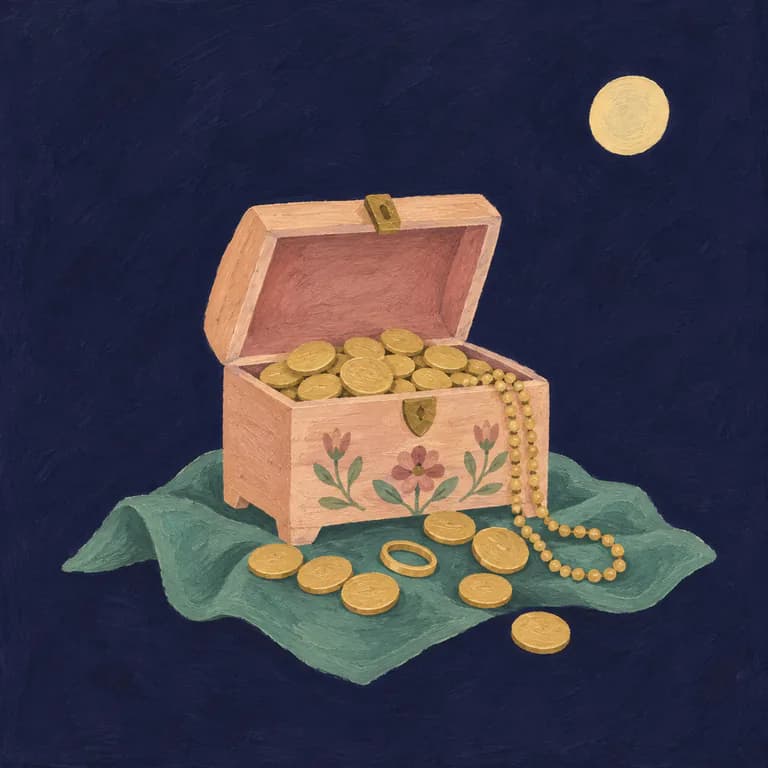
Gold nos sonhos: o que pode significar
- Dinheiro
- Amor e relacionamentos
Esta página ainda não está disponível no idioma Português (Brasil), por isso você está lendo a versão em inglês.
RascunhoEsta página ainda não foi revisada por um editor.
A resposta breve
Gold carries value, reward and sometimes greed. Many dreamers connect it with what they treasure, what they feel they have earned, or what they are afraid to lose.
Seu sonho é só seu
Conte do jeito que você lembra. Você recebe uma interpretação sobre seu sonho e sua vida, não um verbete de dicionário.
Três formas de interpretar
Psicologia e pesquisa
PesquisaThe continuity view reads valuable objects in dreams through the dreamer's own concerns about worth, security and reward. Finding money is also one of the pleasant typical themes people report in dream surveys. Ask what the gold was worth to you in the dream: a gift, a discovery, something stolen or something you had to guard.
- Domhoff 2001
- Nielsen et al. 2003
Tradição popular
Tradição, não ciênciaTradição: American popular dream books, around 1900
Miller's 1901 dream dictionary read handling gold as a sign of success in what one undertakes, and losing gold as missed chances. It reflects one popular tradition of its time, reported here as history rather than a forecast.
- Miller 1901
Perguntas para você refletir
- What do you treasure right now that is not money?
- Did the gold feel earned, given or taken?
- Is there something you are afraid of losing?
Símbolos relacionados
Fontes
Todas as interpretações desta página vêm destas obras. Ainda há referências de páginas que não foram conferidas; elas estão sinalizadas.
G. William Domhoff (2001). A New Neurocognitive Theory of Dreams. Dreaming 11(1): 13-33.
citado, não reproduzido
- Local da citação: pp. 13-33 (dreams as simulations of personal concerns) (referência ainda não conferida)
Dreams as embodied simulations of personal concerns (the continuity view). The backbone of our psychology lens.
Tore A. Nielsen, Antonio L. Zadra, Valérie Simard, Sébastien Saucier, Philippe Stenstrom, Carlyle Smith, Don Kuiken (2003). The typical dreams of Canadian university students. Dreaming 13(4): 211-235.
citado, não reproduzido
- Local da citação: typical dreams questionnaire, results (referência ainda não conferida)
Survey of how many people report having had common dream themes (being chased, falling, teeth, flying, exams, nakedness and others) at least once.
Gustavus Hindman Miller (1901). What's in a Dream (later reissued as Ten Thousand Dreams Interpreted).
domínio público
- Local da citação: entry: Gold (referência ainda não conferida)
An American popular dream dictionary. Its entries are written as omens ("foretells"); we only report how people once read a symbol, never as a forecast.