
Zhuangzi (Zhuang Zhou)4th century BCE (traditional)
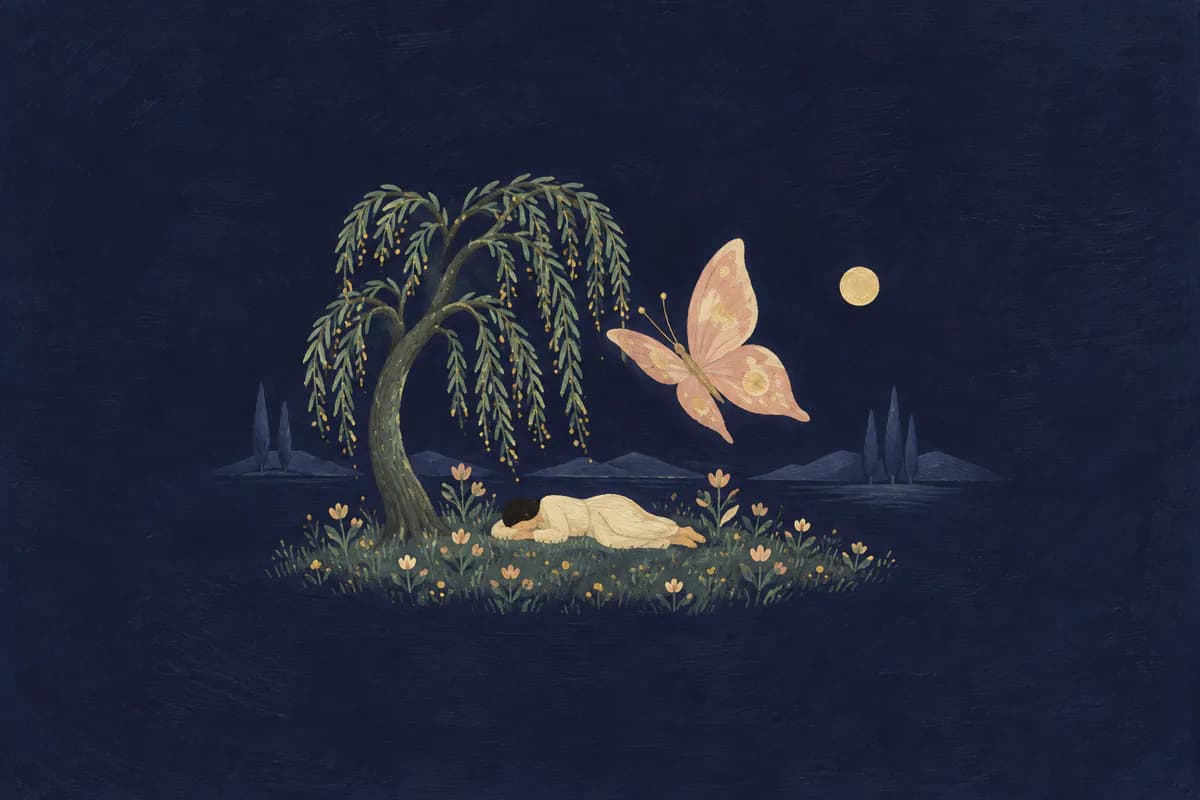
Zhuangzi's butterfly dream
Did the philosopher dream he was a butterfly, or is a butterfly now dreaming it is a philosopher? Two thousand years later the question still unsettles people.
Diese Seite ist für die Sprache Deutsch noch nicht verfügbar. Deshalb liest du die englische Version.
EntwurfDiese Seite wurde noch nicht redaktionell geprüft.
Der Traum
Nach den unten genannten Quellen in eigenen Worten nacherzählt, nicht zitiert.
The Chinese philosopher Zhuang Zhou once dreamed he was a butterfly, fluttering about happily, doing as it pleased, with no idea that it was Zhou.
Then he woke up, and there he was, unmistakably Zhou. But he could not tell whether he was Zhou who had dreamed of being a butterfly, or a butterfly now dreaming of being Zhou. Between Zhou and a butterfly, the passage ends, there must be some distinction; this is what is called the transformation of things.
- Zhuangzi 1889
Woher die Geschichte stammt
The story closes the second chapter of the Zhuangzi, a Daoist classic traditionally attributed to Zhuang Zhou, who lived in the fourth century BCE. The book was compiled over a long period and scholars agree that not all of it is by him, but this chapter is usually counted among the earliest parts.
It is less a dream report than a philosophical parable, and one of the most quoted passages in Chinese literature. We retell it from Herbert Giles's public-domain translation of 1889.
Wie der Traum gedeutet wurde
Klassische Texte
In the Zhuangzi the point is not what the butterfly means but what the dream does: it loosens our certainty about which state is the real one. The chapter argues against fixed distinctions, and the butterfly is its most memorable example of how easily one identity becomes another.
- Zhuangzi 1889
Forschung
Dream science has its own version of the puzzle. While we dream we rarely notice that we are dreaming; lucid dreams, in which the dreamer knows, are the exception. The feeling of being fully convinced by a dream world is one of the most studied features of ordinary dreaming.
- Zadra & Stickgold 2021
Fragen zu deinen eigenen Träumen
- Have you ever woken unsure for a moment which world was real?
- In dreams, are you ever someone or something other than yourself?
- What in your life feels more like you than your everyday self does?
Symbole in diesem Traum
Hattest du einen Traum, der dir im Gedächtnis geblieben ist?
Meinen Traum erzählenQuellen
Jede Deutung auf dieser Seite stammt aus diesen Werken. Noch sind nicht alle Seitenangaben geprüft. Ausstehende Prüfungen sind gekennzeichnet.
Zhuangzi (Chuang Tzŭ) (1889). Chuang Tzŭ: Mystic, Moralist, and Social Reformer, übersetzt von Herbert A. Giles. London: Bernard Quaritch.
erstmals veröffentlicht: 4th-3rd century BCE
gemeinfrei
- Fundstelle: ch. II, closing passage (Fundstelle noch nicht geprüft)
- Fundstelle: ch. II (Fundstelle noch nicht geprüft)
Antonio Zadra, Robert Stickgold (2021). When Brains Dream: Exploring the Science and Mystery of Sleep. New York: W. W. Norton.
als Quelle angeführt, nicht vervielfältigt
- Fundstelle: chapter on lucid dreaming (Fundstelle noch nicht geprüft)
NEXTUP model: dreaming explores weak, unexpected associations between memories.