
Zhuangzi (Zhuang Zhou)4th century BCE (traditional)
Zhuangzi's butterfly dream
Did the philosopher dream he was a butterfly, or is a butterfly now dreaming it is a philosopher? Two thousand years later the question still unsettles people.
Esta página aún no está disponible en el idioma que elegiste (Español), así que estás viendo la versión en inglés.
BorradorEsta página aún no ha sido revisada por un editor.
El sueño
Narrado con nuestras propias palabras a partir de las fuentes indicadas abajo, sin citas textuales.
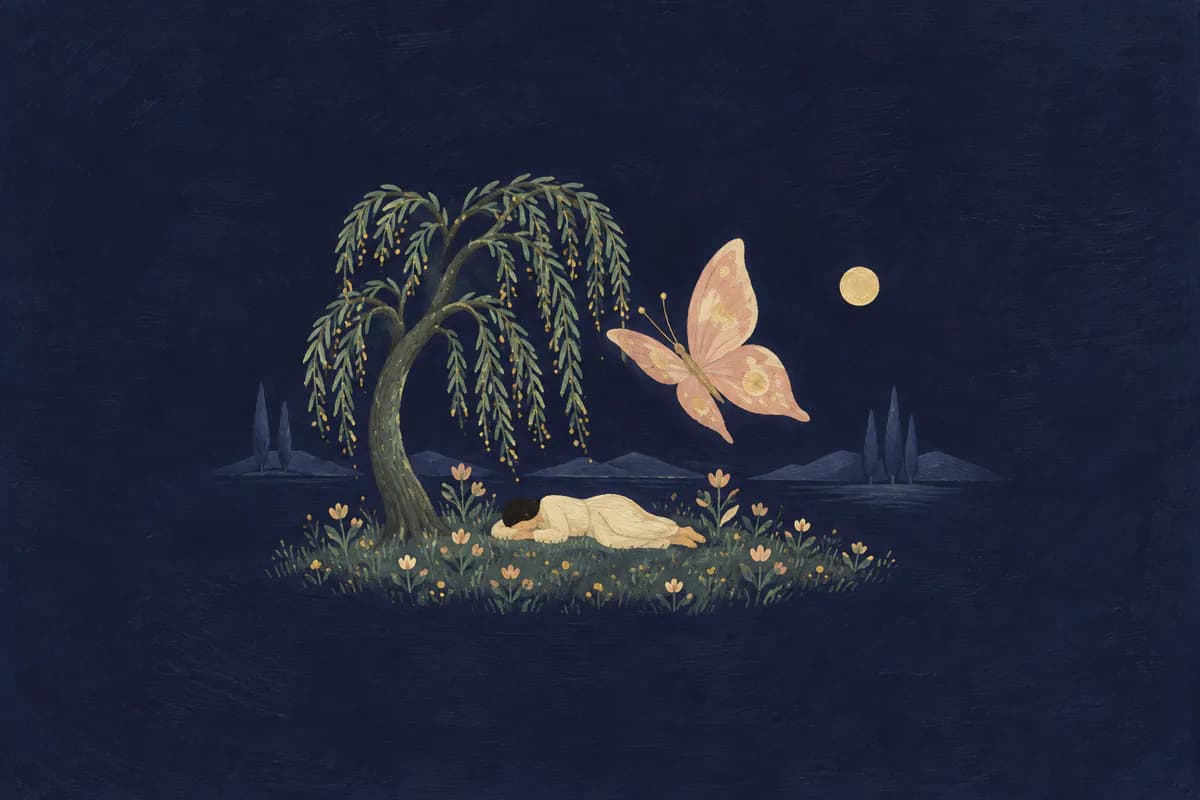
The Chinese philosopher Zhuang Zhou once dreamed he was a butterfly, fluttering about happily, doing as it pleased, with no idea that it was Zhou.
Then he woke up, and there he was, unmistakably Zhou. But he could not tell whether he was Zhou who had dreamed of being a butterfly, or a butterfly now dreaming of being Zhou. Between Zhou and a butterfly, the passage ends, there must be some distinction; this is what is called the transformation of things.
- Zhuangzi 1889
De dónde viene la historia
The story closes the second chapter of the Zhuangzi, a Daoist classic traditionally attributed to Zhuang Zhou, who lived in the fourth century BCE. The book was compiled over a long period and scholars agree that not all of it is by him, but this chapter is usually counted among the earliest parts.
It is less a dream report than a philosophical parable, and one of the most quoted passages in Chinese literature. We retell it from Herbert Giles's public-domain translation of 1889.
Cómo se ha interpretado
Textos clásicos
In the Zhuangzi the point is not what the butterfly means but what the dream does: it loosens our certainty about which state is the real one. The chapter argues against fixed distinctions, and the butterfly is its most memorable example of how easily one identity becomes another.
- Zhuangzi 1889
Investigación
Dream science has its own version of the puzzle. While we dream we rarely notice that we are dreaming; lucid dreams, in which the dreamer knows, are the exception. The feeling of being fully convinced by a dream world is one of the most studied features of ordinary dreaming.
- Zadra & Stickgold 2021
Preguntas para tus propios sueños
- Have you ever woken unsure for a moment which world was real?
- In dreams, are you ever someone or something other than yourself?
- What in your life feels more like you than your everyday self does?
Símbolos de este sueño
¿Has tenido un sueño que no has podido olvidar?
Contar mi sueñoFuentes
Todas las interpretaciones de esta página se basan en estas obras. Aún no se han comprobado todas las referencias a páginas; las pendientes están marcadas.
Zhuangzi (Chuang Tzŭ) (1889). Chuang Tzŭ: Mystic, Moralist, and Social Reformer, traducción de Herbert A. Giles. London: Bernard Quaritch.
primera publicación: 4th-3rd century BCE
dominio público
- Ubicación de la cita: ch. II, closing passage (referencia aún sin comprobar)
- Ubicación de la cita: ch. II (referencia aún sin comprobar)
Antonio Zadra, Robert Stickgold (2021). When Brains Dream: Exploring the Science and Mystery of Sleep. New York: W. W. Norton.
citado, no reproducido
- Ubicación de la cita: chapter on lucid dreaming (referencia aún sin comprobar)
NEXTUP model: dreaming explores weak, unexpected associations between memories.