
Zhuangzi (Zhuang Zhou)4th century BCE (traditional)
Zhuangzi's butterfly dream
Did the philosopher dream he was a butterfly, or is a butterfly now dreaming it is a philosopher? Two thousand years later the question still unsettles people.
Esta página ainda não está disponível no idioma Português (Brasil), por isso você está lendo a versão em inglês.
RascunhoEsta página ainda não foi revisada por um editor.
O sonho
Recontado com nossas próprias palavras a partir das fontes abaixo, sem citação literal.
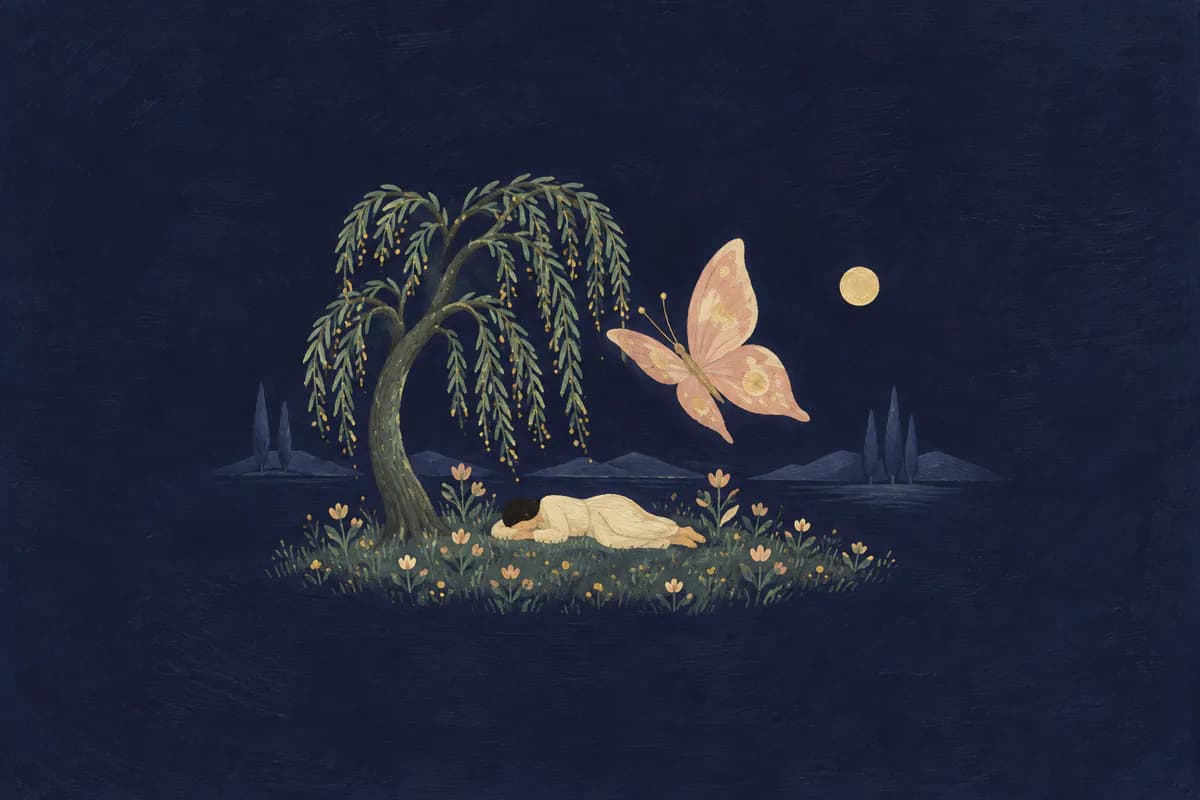
The Chinese philosopher Zhuang Zhou once dreamed he was a butterfly, fluttering about happily, doing as it pleased, with no idea that it was Zhou.
Then he woke up, and there he was, unmistakably Zhou. But he could not tell whether he was Zhou who had dreamed of being a butterfly, or a butterfly now dreaming of being Zhou. Between Zhou and a butterfly, the passage ends, there must be some distinction; this is what is called the transformation of things.
- Zhuangzi 1889
De onde vem a história
The story closes the second chapter of the Zhuangzi, a Daoist classic traditionally attributed to Zhuang Zhou, who lived in the fourth century BCE. The book was compiled over a long period and scholars agree that not all of it is by him, but this chapter is usually counted among the earliest parts.
It is less a dream report than a philosophical parable, and one of the most quoted passages in Chinese literature. We retell it from Herbert Giles's public-domain translation of 1889.
Como foi interpretado
Textos clássicos
In the Zhuangzi the point is not what the butterfly means but what the dream does: it loosens our certainty about which state is the real one. The chapter argues against fixed distinctions, and the butterfly is its most memorable example of how easily one identity becomes another.
- Zhuangzi 1889
Pesquisa
Dream science has its own version of the puzzle. While we dream we rarely notice that we are dreaming; lucid dreams, in which the dreamer knows, are the exception. The feeling of being fully convinced by a dream world is one of the most studied features of ordinary dreaming.
- Zadra & Stickgold 2021
Perguntas para seus próprios sonhos
- Have you ever woken unsure for a moment which world was real?
- In dreams, are you ever someone or something other than yourself?
- What in your life feels more like you than your everyday self does?
Símbolos neste sonho
Teve um sonho que marcou você?
Quero contar meu sonhoFontes
Todas as interpretações desta página vêm destas obras. Ainda há referências de páginas que não foram conferidas; elas estão sinalizadas.
Zhuangzi (Chuang Tzŭ) (1889). Chuang Tzŭ: Mystic, Moralist, and Social Reformer, tradução de Herbert A. Giles. London: Bernard Quaritch.
primeira publicação: 4th-3rd century BCE
domínio público
- Local da citação: ch. II, closing passage (referência ainda não conferida)
- Local da citação: ch. II (referência ainda não conferida)
Antonio Zadra, Robert Stickgold (2021). When Brains Dream: Exploring the Science and Mystery of Sleep. New York: W. W. Norton.
citado, não reproduzido
- Local da citação: chapter on lucid dreaming (referência ainda não conferida)
NEXTUP model: dreaming explores weak, unexpected associations between memories.