
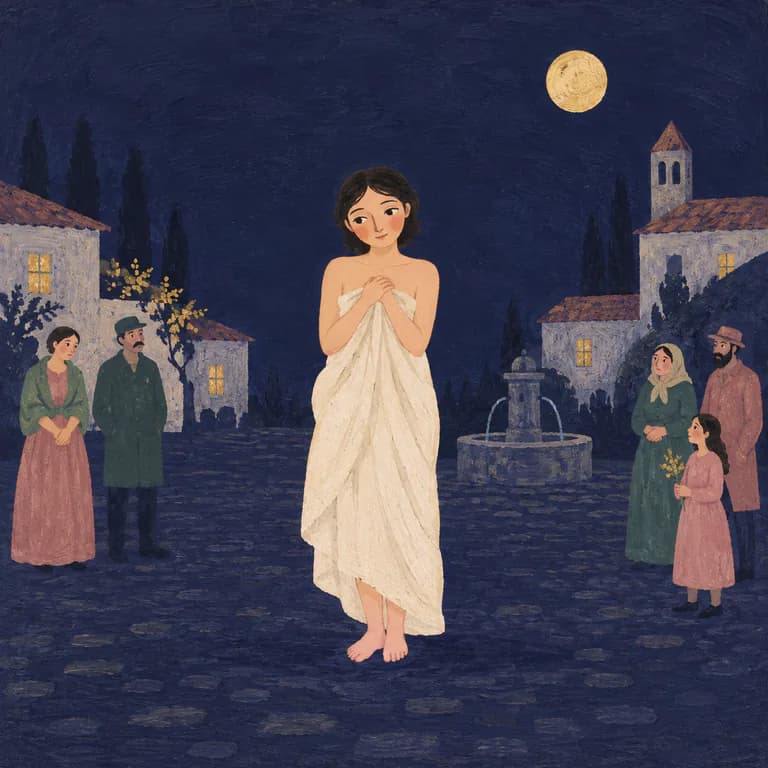
Naked in public im Traum: Was es bedeuten kann
- Auf dem Prüfstand
- Körper
Diese Seite ist für die Sprache Deutsch noch nicht verfügbar. Deshalb liest du die englische Version.
EntwurfDiese Seite wurde noch nicht redaktionell geprüft.
Die kurze Antwort
Being naked or wrongly dressed in public is a classic embarrassment dream. It usually tracks worry about being exposed, judged or unprepared, and often nobody in the dream even notices.
Dein Traum ist ganz persönlich
Erzähl ihn so, wie du dich erinnerst. Du erhältst eine Deutung zu deinem Traum und deinem Leben, keinen Lexikoneintrag.
Wege zur Deutung
Psychologie und Forschung
ForschungNakedness in public shows up on typical-dream lists in survey research. A continuity reading connects it with situations where you feel exposed: a new job, sharing something personal, being evaluated, or fear that others will see a weakness. Many dreamers notice that the people around them do not react at all, a detail that can point to the gap between how judged we feel and how much others notice.
- Nielsen et al. 2003
- Domhoff 2001
Klassische Texte
GeschichteFreud opened his discussion of typical dreams with the embarrassment dream of nakedness and pointed out the same curious detail: the dreamer is ashamed, yet the onlookers seem indifferent. His own explanation, tied to early childhood, is not supported by later research, but his description of the dream is still recognisable.
- Freud 1913
Volkstümliche Überlieferung
Tradition, keine WissenschaftTradition: American popular dream books, around 1900
Dream books around 1900 read nakedness as a warning of scandal or unwise actions. That reflects the morals of the time and is not a prediction.
- Miller 1901
Fragen an dich selbst
- Where do you feel exposed or on show at the moment?
- Did anyone in the dream actually notice or react?
- What would you need in order to feel prepared?
Verwandte Symbole
Quellen
Jede Deutung auf dieser Seite stammt aus diesen Werken. Noch sind nicht alle Seitenangaben geprüft. Ausstehende Prüfungen sind gekennzeichnet.
Tore A. Nielsen, Antonio L. Zadra, Valérie Simard, Sébastien Saucier, Philippe Stenstrom, Carlyle Smith, Don Kuiken (2003). The typical dreams of Canadian university students. Dreaming 13(4): 211-235.
als Quelle angeführt, nicht vervielfältigt
- Fundstelle: typical dreams questionnaire, results (Fundstelle noch nicht geprüft)
Survey of how many people report having had common dream themes (being chased, falling, teeth, flying, exams, nakedness and others) at least once.
G. William Domhoff (2001). A New Neurocognitive Theory of Dreams. Dreaming 11(1): 13-33.
als Quelle angeführt, nicht vervielfältigt
- Fundstelle: pp. 13-33 (dreams as simulations of personal concerns) (Fundstelle noch nicht geprüft)
Dreams as embodied simulations of personal concerns (the continuity view). The backbone of our psychology lens.
Sigmund Freud (1913). The Interpretation of Dreams, übersetzt von A. A. Brill. New York: Macmillan.
erstmals veröffentlicht: 1900
gemeinfrei
- Fundstelle: Ch. V, section D, typical dreams (the embarrassment dream of nakedness) (Fundstelle noch nicht geprüft)
First English translation, of the third German edition. Public domain; scholars consider it looser than the later Strachey translation, which is copyrighted.
Gustavus Hindman Miller (1901). What's in a Dream (later reissued as Ten Thousand Dreams Interpreted).
gemeinfrei
- Fundstelle: entry: Nakedness (Fundstelle noch nicht geprüft)
An American popular dream dictionary. Its entries are written as omens ("foretells"); we only report how people once read a symbol, never as a forecast.