
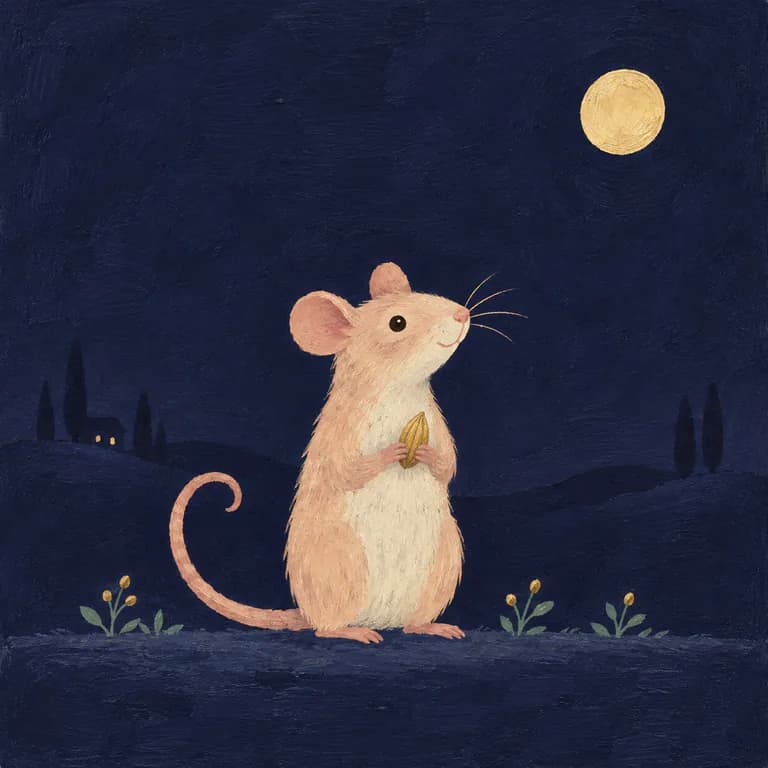
Rat im Traum: Was es bedeuten kann
- Tiere
- Angst und Gefahr
- Orte
Diese Seite ist für die Sprache Deutsch noch nicht verfügbar. Deshalb liest du die englische Version.
EntwurfDiese Seite wurde noch nicht redaktionell geprüft.
Die kurze Antwort
Rats often bring disgust and a sense that something unwanted has got in. Many dreamers link them to a worry that feels small but persistent, or to someone they no longer trust.
Dein Traum ist ganz persönlich
Erzähl ihn so, wie du dich erinnerst. Du erhältst eine Deutung zu deinem Traum und deinem Leben, keinen Lexikoneintrag.
Wege zur Deutung
Psychologie und Forschung
ForschungResearchers who code dream content note both the animals that appear and the emotions attached to them. Disgust and unease are common with rats and mice, and on the continuity view that feeling is the thread back to waking life. Ask what has been gnawing at you: a hidden problem, a leak of money or energy, or a situation that feels contaminated.
- Hall & Van de Castle 1966
- Domhoff 2001
Klassische Texte
GeschichteArtemidorus read a mouse as a household servant, reasoning that it lives under the same roof and eats the same food as the family. For him the image was about the people close to the household and whether they could be trusted, a reminder that his readings were built on the dreamer's own circumstances.
- Artemidorus 1644
Volkstümliche Überlieferung
Tradition, keine WissenschaftTradition: American popular dream books, around 1900
Miller's 1901 dream dictionary read rats as a sign of being deceived or wronged by people nearby, and catching or killing them as getting the better of that trouble. This was a popular reading of its time, not a forecast.
- Miller 1901
Fragen an dich selbst
- What in your life feels like it is quietly eating away at something?
- Was the rat in your own space? What would it mean to you if something had got into your home?
- Is there someone you are unsure you can trust at the moment?
Verwandte Symbole
Quellen
Jede Deutung auf dieser Seite stammt aus diesen Werken. Noch sind nicht alle Seitenangaben geprüft. Ausstehende Prüfungen sind gekennzeichnet.
Calvin S. Hall, Robert L. Van de Castle (1966). The Content Analysis of Dreams. New York: Appleton-Century-Crofts.
als Quelle angeführt, nicht vervielfältigt
- Fundstelle: coding categories: animals and emotions (Fundstelle noch nicht geprüft)
The standard coding system for dream content (characters, social interactions, misfortunes, emotions, settings, objects) and its normative sample.
G. William Domhoff (2001). A New Neurocognitive Theory of Dreams. Dreaming 11(1): 13-33.
als Quelle angeführt, nicht vervielfältigt
- Fundstelle: pp. 13-33 (dreams as simulations of personal concerns) (Fundstelle noch nicht geprüft)
Dreams as embodied simulations of personal concerns (the continuity view). The backbone of our psychology lens.
Artemidorus of Daldis (1644). The Interpretation of Dreams (Oneirocritica), in five books, übersetzt von Robert Wood. London.
erstmals veröffentlicht: 2nd century CE
gemeinfrei
- Fundstelle: Book III, on the mouse (Fundstelle noch nicht geprüft)
Greek dream manual from the Roman era. We paraphrase the public-domain Wood translation (1644). Modern translations (White 1975, Harris-McCoy 2012, Hammond 2020) are copyrighted and only cited.
Gustavus Hindman Miller (1901). What's in a Dream (later reissued as Ten Thousand Dreams Interpreted).
gemeinfrei
- Fundstelle: entry: Rats (Fundstelle noch nicht geprüft)
An American popular dream dictionary. Its entries are written as omens ("foretells"); we only report how people once read a symbol, never as a forecast.